“What’s in Your Sketchbook?” A Chat with Charley Harper
by Bruce Petrie Jr., Board of Trustees Chair, Cincinnati Art Museum
5/13/2026
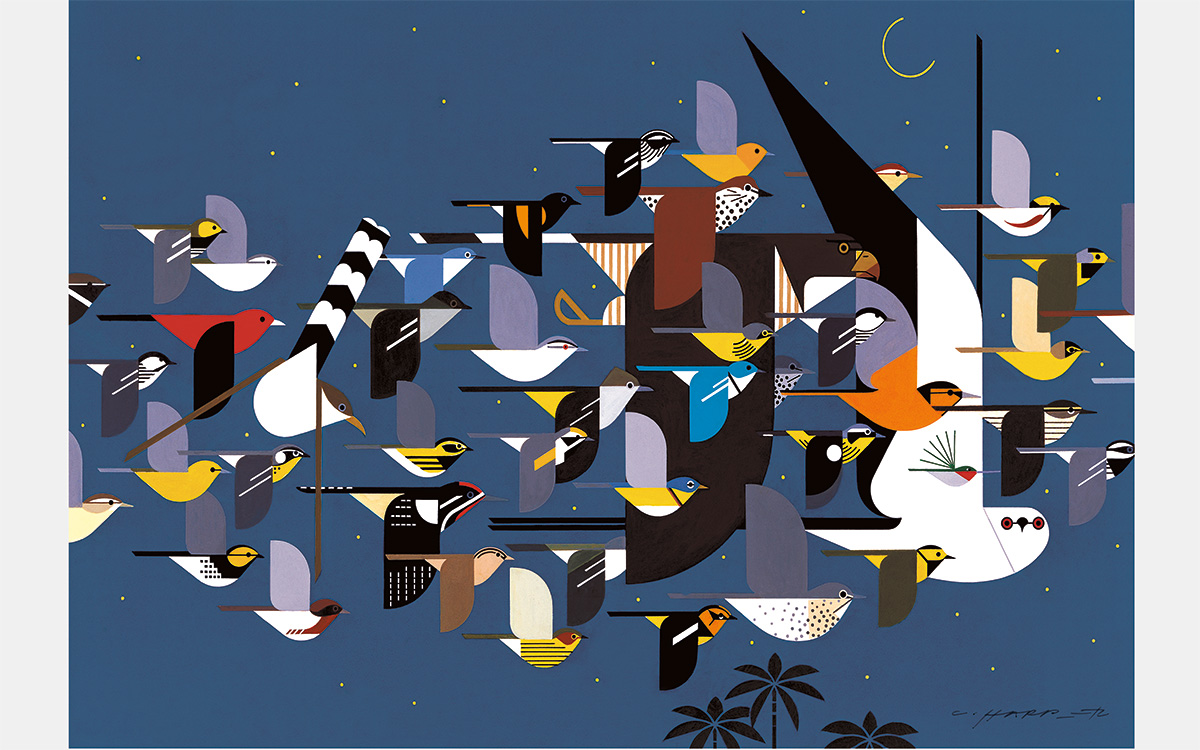
Charley Harper (American, 1922–2007), Mystery of the Missing Migrants, 1990, acrylic on canvas mounted on board, Mass Audubon Collection; purchase 1992, © Charley Harper, all rights reserved.
I first met Charley Harper in the mid-1970s when I was in my early twenties, and he was in his early fifties. Charley and his wife Edie were working artists in Cincinnati, visiting northern Michigan with my parents. My father was Charley’s friend and lawyer, and my mother was a longtime docent at the Cincinnati Art Museum.
Looking back now after half a century (with my parents and the Harpers long passed) I think of that day and place as a happy, relaxed, natural setting — call it “Harper-esque.” Late afternoon light on the lake; gulls perched on the dock; swallows darting; a pair of neighborhood crows with an occasional “cawwww”; and adults smiling and chatting on the deck in jeans and swimsuits right before drinks and dinner outdoors.
The Harpers were great company, playful in their fifties — Charley a punster, filled with stories of birds and art making — down-to-earth Cincinnati Midwestern. The Harpers exuded kindness, which extended not only to human varieties but to all creatures great and small.
Wildlife artists have bird-like qualities. On first seeing a nineteenth-century photo portrait of John James Audubon, I thought his eyes and features were hawk-like. Charley Harper wasn’t like Audubon in his art or semblance; Charley saw through a lens of design minimalism while Audubon’s eye was more literal. But both were great artists because first they were keen observers — they observed in different but powerful ways that others just didn’t see. Like birds do.
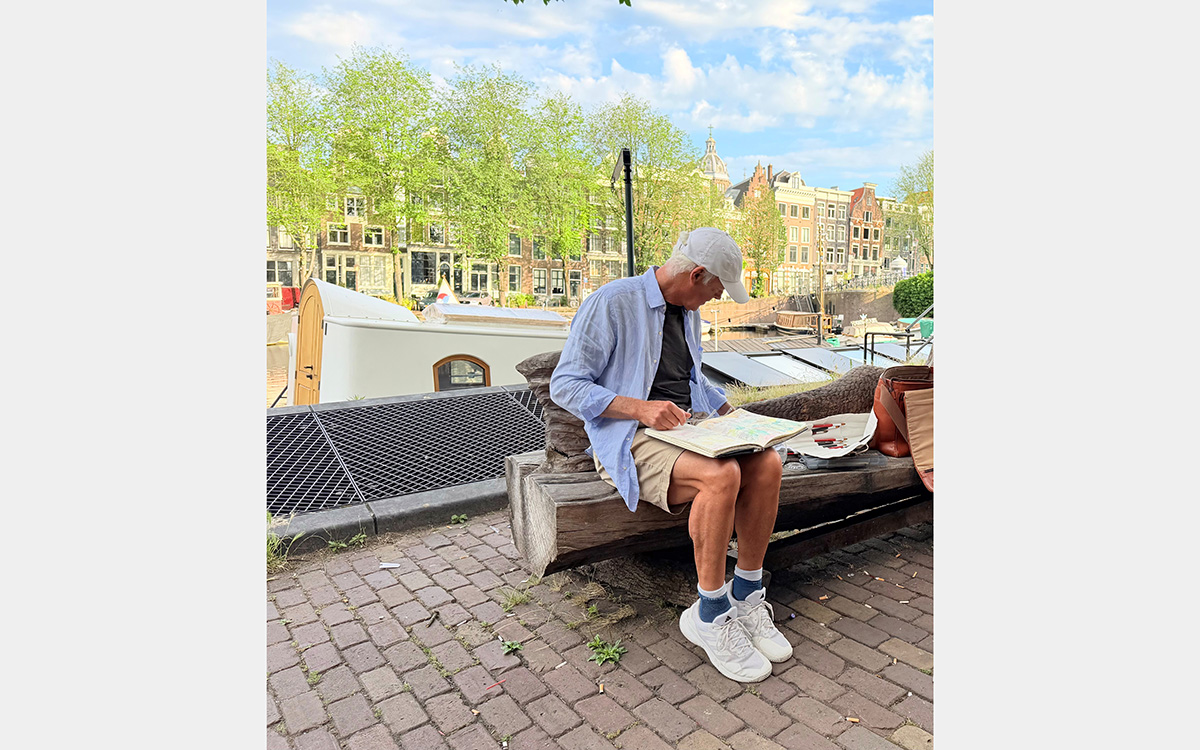
Along with observation, was drawing. Lots and lots of drawing from life. Love of life drawing, pencil in hand, in the field, not from cell phones in the basement, but direct observation outside translated with eye and hand into sketchbook; working through shapes, line, figure, light, telltale features, composition. Talent is often a misnomer in such art making that is more about seeing, diligence, visual language, and what naturalist E.O. Wilson called biophilia, love of nature.
When I first met Charley Harper sitting on the deck in Michigan, I had my sketchbook with me. I’d just come back from an afternoon of drawing in the rural landscape, rolling fields, rows of cut hay, an old barn, swallows, an owl, light and shadows. My parents introduced him to me as Mr. Harper. I knew he was an artist, and he knew I loved to draw.
“What’s in your sketchbook?” Mr. Harper asked. I handed it over and he quietly paged through the drawings as we sat on the deck overlooking the lake. I was a college freelance illustrator and cartoonist at the time, so my sketches were not only landscapes but caricatures and illustrations for various projects in progress. As he turned the pages, I watched his encouraging reactions and smiles. A much younger self, I saw in him as a modest, kind, silver-haired artist in his prime — and on his way to more discovery and renown than he knew. His work was his own reward, but others would love what he loved and recognize the distinctive designs of Charley Harper.
Life went on, and the Harper studio in Cincinnati grew, a family affair with Charley, Edie, and artist son Brett. As we say in art, Charley “designed flat rather than round.” Harper-esque designs are on a flat picture plane, not rounded into the tricks of three-dimensional perspective. Nothing is 100% brand new in art history; everything borrows from the past as did Charley Harper. But we can see today as he once did — a bird in flight, a moment of truth both uniquely his and universally ours.
Related Blog Posts

Cincinnati, OH 45202
Toll Free: 1 (877) 472-4226
Museum Hours
Museum Shop
Terrace Café
Library
Cincinnati Art Museum is supported by the tens of thousands of people who give generously to the annual ArtsWave Campaign, the region's primary source for arts funding.

Free general admission to the Cincinnati Art Museum is made possible by a gift from the Rosenthal Family Foundation. Exhibition pricing may vary. Parking at the Cincinnati Art Museum is free.
Generous support for our extended Thursday hours is provided by Art Bridges Foundation’s Access for All program.

General operating support provided by: