Introduction
I’m Eric Hughett, the museum’s curatorial assistant for East Asian Art. I am reading highlighted exhibition text for Rediscovered Treasures.
Rediscovered Treasures features nearly 60 artworks selected from the Cincinnati Art Museum’s East Asian Art collection. Each of these artworks tell a fascinating story of how it was rediscovered through scholarship or conservation. This exhibition also focuses on two key institutional goals of the museum’s mission: the preservation and interpretation of cultural objects.
The museum acquired the core of its East Asian art collection in the late nineteenth century when Cincinnati became a flourishing cultural center in the Midwest. However, as many of these works entered the museum, they were often left unidentified, misidentified, or sometimes not accessioned due to a lack of information at the time. Over the past two decades, new research on these and other works in the collection has led to many exciting discoveries of not only new information about the works themselves, but also their history and provenance.
This exhibition is divided into three sections: Uncovering Hidden Gems, Revealing Identities, and Preserving Legacies.
Uncovering Hidden Gems
Founded in 1881, the museum is home to one of the oldest East Asian art collections in the United States. However, the core of this collection, particularly those objects that entered the museum in the late nineteenth century, was poorly documented due to the lack of expertise to identify Asian art at the time. This section encourages visitors to rediscover these early works, which were not accessioned until 2002, when the museum first established its Asian Art Department.
Alphabetic Scrolls
The first major rediscovery occurred shortly after the curator of East Asian art joined the museum in 2002. Among the earliest gifts to the museum, 23 Japanese paintings known as the “Alphabetic Scrolls” (A to U) lacked information and provenance and, therefore, had never been accessioned. After searching through the museum’s archives and records, the curator traced this group of paintings to the estate of Robert Blum (1857–1903), a Cincinnati painter who visited Japan from 1890 to 1892. While in Japan, Blum developed a strong interest in Japanese art and built a substantial collection, including paintings, prints, and Nō masks, which was later donated to the museum.
While the “Alphabetic Scrolls” entered the museum in 1906, they were not accessioned until 2006. In the same year, the museum received a grant to conserve six scrolls (A, D, L, M, and Q), all included in this exhibition. Since then, the museum has conserved additional scrolls (including F, G, and S).
Portrait of an Actor with a Black Mask and Bells
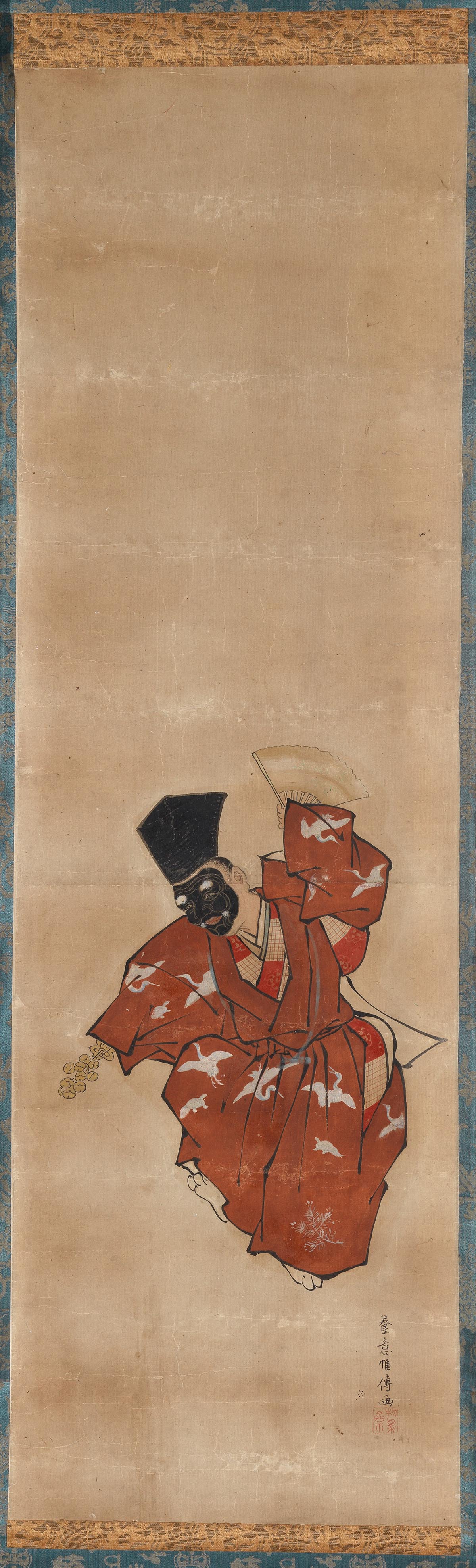
Sasayama Yōi 笹山養意 (Japanese, d. 1743), Portrait of an Actor with a Black Mask and Bells, Edo period (1615–1868), hanging scroll, ink and color on paper, Gift of the Robert F. Blum Estate, 1906.14
Description
This is the description of Portrait of an Actor with a Black Mask and Bells in Rediscovered Treasures.
Portrait of an Actor with a Black Mask and Bells is an ink and color hanging scroll. The scroll was created during the Edo Period (1615-1868) by Sasayama Yoi, a Japanese artist who died in 1743. The scroll was a gift to the Cincinnati Art Museum from the Robert F. Blum Estate, and the registration number is 1906.14.
Portrait of an Actor with a Black Mask and Bells is a vertically oriented scroll that measures 69 ¼ by 14 9/16 inches. The artwork depicts a man jumping in midair against a bare background. He is wearing a red robe adorned with white animal motifs and plants. Underneath the robe, he has on a checkered undergarment in shades of red and tan. In his right hand, the man holds a string of golden bells, while his left hand carries a fan. He has black hair and wears a tall, rectangular black headpiece. The black mask he wears features distinct outlines around the forehead, nose, and chin, with white eyebrows and white fur near the lips. A line of vertically written characters is present underneath the man’s left foot.
Label
This is the label for Portrait of an Actor with a Black Mask and Bells in Rediscovered Treasures.
Depicting an actor performing a ritual dance in a Nō drama, this painting by Sasayama Yōi was formerly Scroll M of the “Alphabetic Scrolls.” The character can be identified as Sanbaso (the Third Old Man), a protagonist of the kyōgen drama who appears in the “Scene of Bells” as a dancer carrying a fan and a string of bells. He also wears a black mask symbolizing his old age. The dance would precede the drama to appease the gods.
Here, Yōi captures the graceful motion of the ritual dance through the subtle tilting of the head, the folds of the robe, the swing of the ribbon and bells, and the angle of the fan. Few of Yōi’s paintings survive, making this signed work a rare masterpiece.
God of Wind
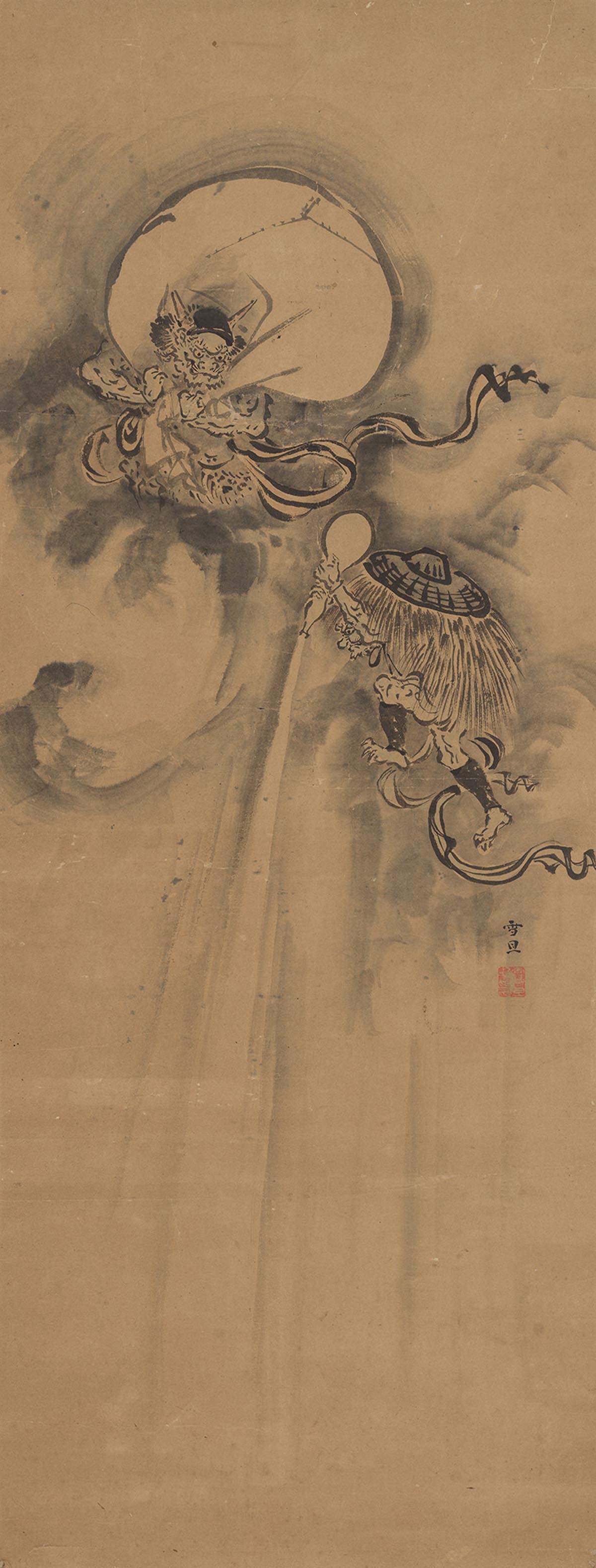
Hasegawa Settan 長谷川雪旦 (Japanese, 1778–1843), God of Wind, Edo period (1615–1868), hanging scroll, ink on paper, Gift of the Robert F. Blum Estate, 1906.18
Description
This is the description of the God of Wind in Rediscovered Treasures.
God of Wind is an ink on paper hanging scroll created by the Japanese artist Hasegawa Settan, who was active from 1778 to 1843. This piece was made during the Edo Period, which lasted from 1615 to 1868. The scroll was given to the Cincinnati Art Museum by the Robert F. Blum Estate, and its registration number is 1906.18.
God of Wind is a vertically oriented hanging scroll that measures 85 9/16 by 26 13/16 inches. The scroll depicts two figures high in the air against a bare tan background. In the top left corner, the first figure is portrayed as a human-like yet monstrous creature with spotted skin, wide eyes, horns, sharp teeth, a broad nose, and a reptilian-like mouth. This figure is accessorized with bracelets and a fitted black cap and has a long piece of fabric flowing around its side. It is holding an enormous sack of wind around its neck and is surrounded by dark wind clouds. The figure below the first has most of its facial and body features obscured by a hat adorned with long, flowing tassels. However, its toned and muscular right arm and legs are visible, along with bare feet and sharp toenails. In its right arm, this figure is emptying a bag of wind. This figure is wearing black calf sleeves and has a long piece of fabric that flows from its lower body past its feet.
Label
This is the label for the God of Wind in Rediscovered Treasures.
In Japan, wind, rain, and thunder gods have long been popular subjects. In this painting, formerly Scroll Q of the “Alphabetic Scrolls,” the image of the Wind God carries a large bag over his shoulder, ready to release the wind contained inside. The deity on the right represents the Rain God, who wears a farmer’s hat and straw cape and pours rainwater from a gourd-shaped pitcher.
Hasegawa Settan was the son of a samurai of the Karatsu domain and lived in Edo (present-day Tokyo). In his early years, Settan was a professional painter earning a living as an illustrator of satirical poetry books and as a portrait painter. He later trained under a Hasegawa school artist, but his existing sketches and contemporary biography indicate extensive training in various painting styles.
Suit of Armor
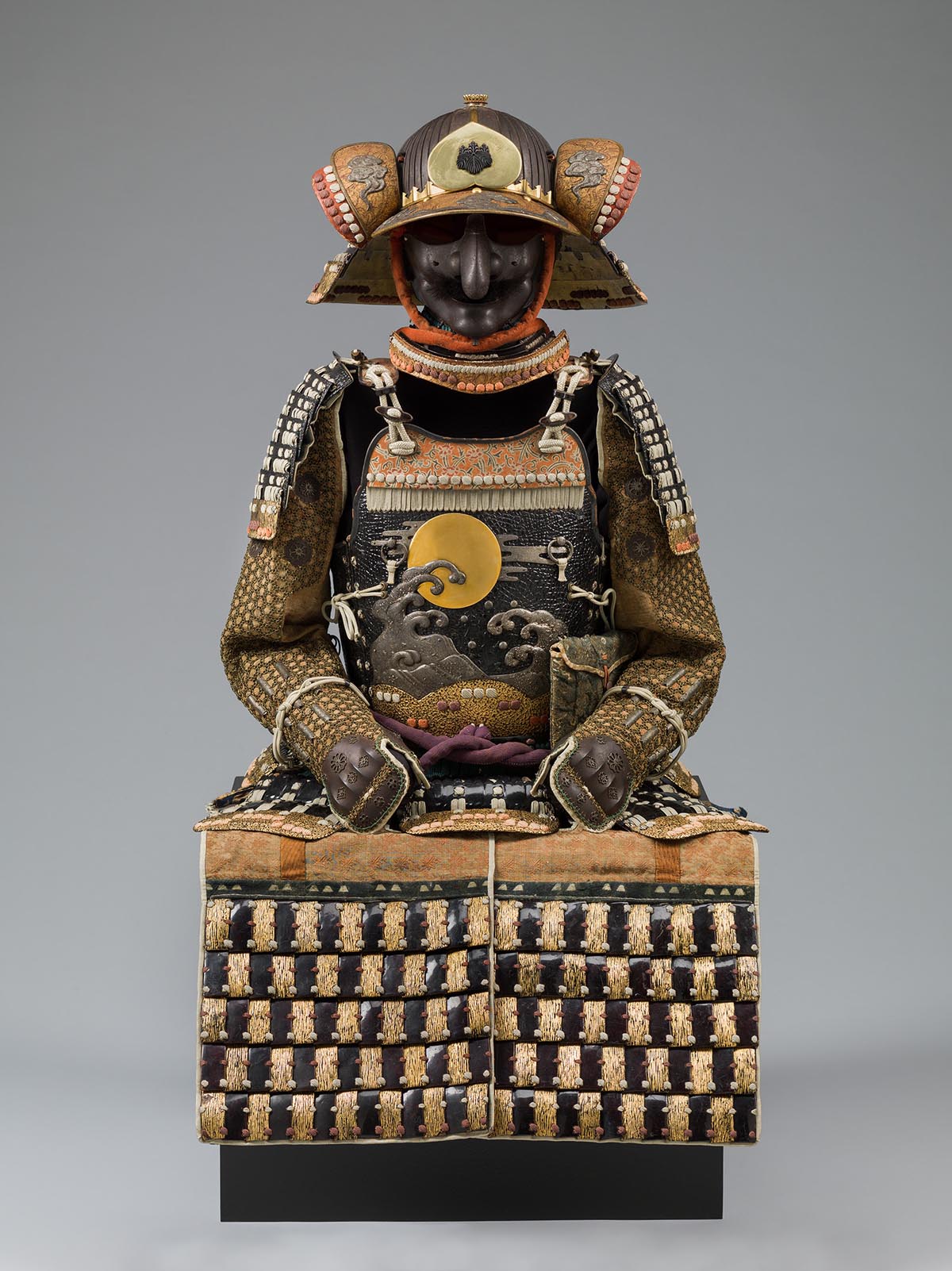
Suit of Armor, Japan, late 18th century, metal, leather, Museum Purchase, 1892.2783
Description
This is the description of the Suit of Armor in Rediscovered Treasures.
Suit of Armor is protective wear made of metal and leather. The armor is from Japan and was made during the late 18th century. The Cincinnati Art Museum purchased this suit of armor, and its registration number is 1892.2784.
Suit of Armor is a vertically oriented protective outfit that includes a helmet, a chest plate, arm guards, and a skirt-like fabric to protect the wearer's legs. The helmet is primarily dome-shaped, featuring two-toned plates on its sides and a curved neck guard. The plates are orange and adorned with abstract cloud imagery, attached to smaller red plates decorated with white and red square dots. At the front of the helmet is a golden, spade-shaped plate with a small black crest in the center. The helmet is attached to a black mask, characterized by a pronounced nose, a broad smile, and hollowed-out eyes, creating a menacing and intimidating expression. An orange rope resides around the sides of the mask. The body component of the armor is a mix of yellow, orange, and black hues. It has long sleeves that provide shoulder padding and coverage for the wearer's hands. The chest plate features a decorative landscape motif, depicting imagery of the sky, waves, and land. A small green pouch resides on the lower right side of the chest plate, and a purple rope is tied around the waist. The bottom half of the armor is long and flowy, showcasing a black and tan checker pattern motif.
Label
This is the label for the Suit of Armor in Rediscovered Treasures.
Crafted in Kaga, Ishikawa Prefecture, this suit of armor dates to the late 1700s. Despite its many decorative elements, the suit’s construction suggests it was intended for use in battle by a high-ranking member of a samurai family.
The frontal crest, composed of three paulownia flowers, is associated with the Ashikaga imperial shogunate (1338–1573). A gold sun rising over splashing silvery waves decorates the front. The luxurious gilt lining on both the front and back is another indication of the owner’s high rank.
Suit of Armor
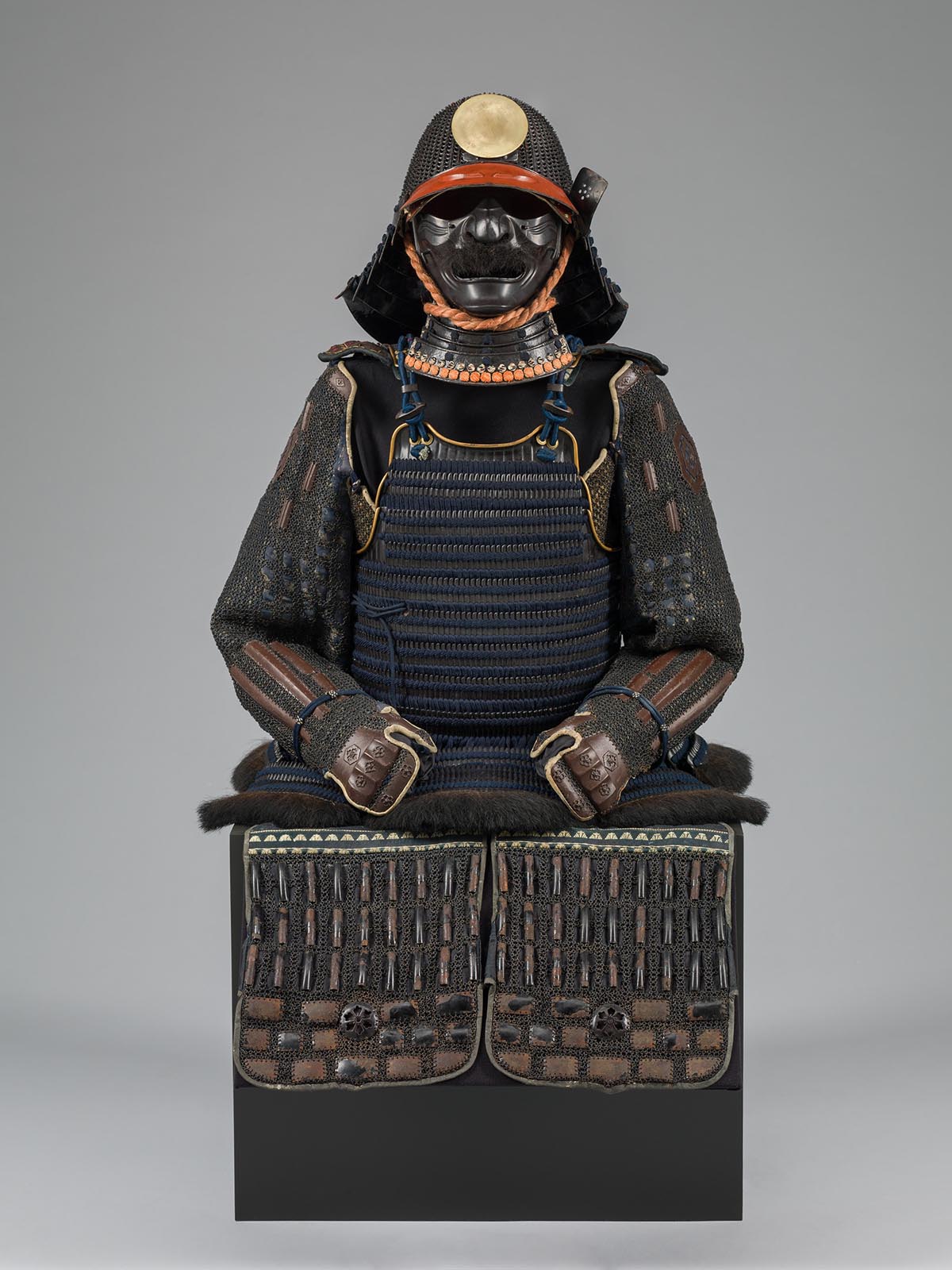
Suit of Armor, Japan, 16th century and 18th century, metal, leather, Museum Purchase, 1892.2784
Description
This is the description of the Suit of Armor in Rediscovered Treasures.
Suit of Armor is protective wear made of metal and leather. The armor is from Japan and was made sometime during the 16th and 18th centuries. The Cincinnati Art Museum purchased this suit of armor, and its registration number is 1892.2784.
Suit of Armor is a vertically oriented protective outfit that consists of a helmet, a chest plate, arm guards, and a skirt-like fabric to protect the wearer's legs. The helmet is a black dome-shaped headwear with a long neck guard. At the center of the helmet, there is a golden plate, and the brim has a bright orange hue. The helmet features a mask with a serious expression, adorned with fur on the upper lip, and an orange rope tied around it. The chest plate has a blend of dark blue, dark brown, and black hues. It has long sleeves that provide protective shoulder padding as well as coverage for the wearer's hands. The chest plate also incorporates blue rope woven into it, creating a horizontal striped pattern of blue and black, with a bear fur trim at the bottom. The skirt piece is decorated with multiple rectangular metal pieces and leather patches interwoven into the fabric.
This is the label for the Suit of Armor in Rediscovered Treasures.
This suit is composed of parts from several sets of armor. The helmet bowl dates to the 1500s; its 62 plates, with more than 2,000 protruding rivets, demonstrate a time-consuming construction process. The frontal crest, the neck guard, and the visor with eyebrows were additions made in the 1700s. It was not unusual for an owner to recycle an especially valuable helmet bowl with up-to-date additions.
Revealing Identities
This section highlights the East Asian artworks in the museum collection that have received new or altered identities over the past two decades through detailed research, much of which is now published. These updated identities include newly identified or changed artists, nationalities, subjects, themes, provenance, and hidden functions. Very often, new findings associated with these objects changed not only the unique significance of individual artworks, but also the overall dynamics of the entire collection.
Eagles and Magpies
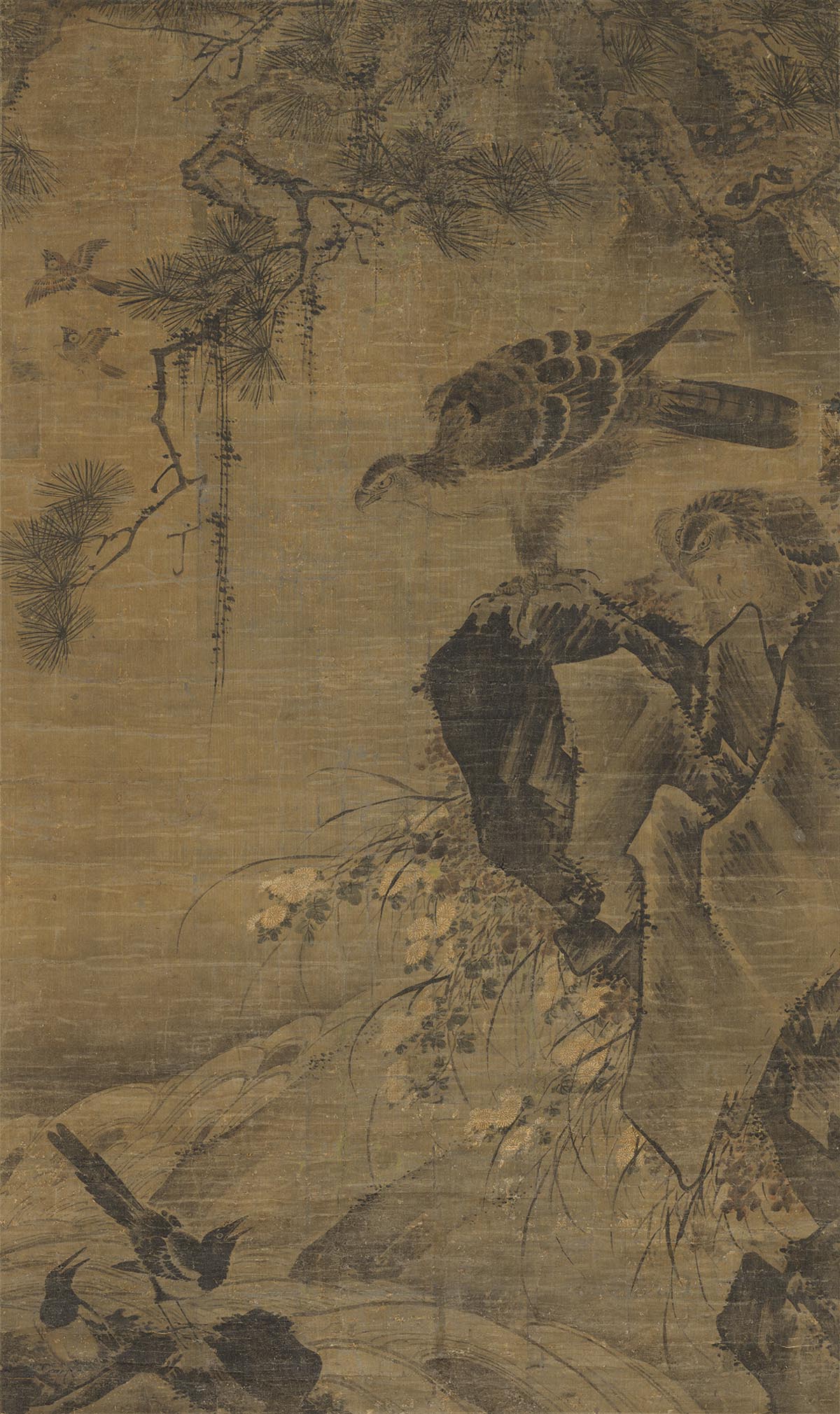
Attributed to Lü Ji 呂紀 (Chinese, ca. 1420s–1504) or his follower, Eagles and Magpies, 16th century, hanging scroll, ink and color on silk, The Edwin and Virginia Irwin Memorial, 2004.160
Description
This is the description of Eagles and Magpies in Rediscovered Treasures.
Eagles and Magpies is an ink and color on silk hanging scroll, created in the 16th century. It is attributed to Lü Ji, a Chinese painter believed to have been active from the 1420s until 1504, or possibly one of his followers. The scroll was bequeathed to the Cincinnati Art Museum's collection by the Edwin and Virginia Irwin Memorial, and its registration number is 2004.160.
Eagles and Magpies is a vertically oriented scroll measuring 102 3/8 by 49 5/8 inches. The artwork depicts a dark and muted-toned scene featuring two eagles staring downward at two magpies. The eagles are toward the center right of the scroll. One eagle stands tall on a rock formation, its body tilted heavily downwards as it gazes sharply at the magpies. The other eagle is slightly behind and lower than the first; its body faces the viewer more, but its gaze is occupied with the magpies. The magpies stand near the lower left-hand side of the scroll. Both magpies are significantly smaller than the eagles, yet they meet the eagles' gaze. The body of the magpie closest to the left corner of the scroll also faces the viewer, but has its head turned towards the eagles with its mouth open. The second magpie stands next to the first; its body tilts downward, but its head is raised high, and its mouth opens wide as it screeches at the eagle. The surrounding background includes a mountain landscape, a sky, flowering trees, and two magpies flying away in the upper left-hand corner of the scroll.
Label
This is the label for Eagles and Magpies in Rediscovered Treasures.
This painting depicts a large male eagle perched on a high cliff and a group of small magpies chirping toward it from below. The odd, unnatural scene and its hidden political message were the topic of research published by Curator Hou-mei Sung in 1995. She discovered the unusual design was based on a well-documented painting created by Lü Ji 呂紀 to offer warning to the Ming Emperor Xiaozong (reigned 1488–1505). Using the homonymic associations of the three key motifs—ying (eagles), ming (calling magpies), and jian (a mountain stream)—Lü ingeniously conveyed the Confucian message of Yingming tingjian, can be read in Chinese as either “應鳴聼澗” (eagles and chirping birds listening to mountain streams) or “英明聼諫” (a wise ruler listening to admonitions). The decoded message was also used to educate the heir apparent for his future rule.
Portrait of a Court Lady
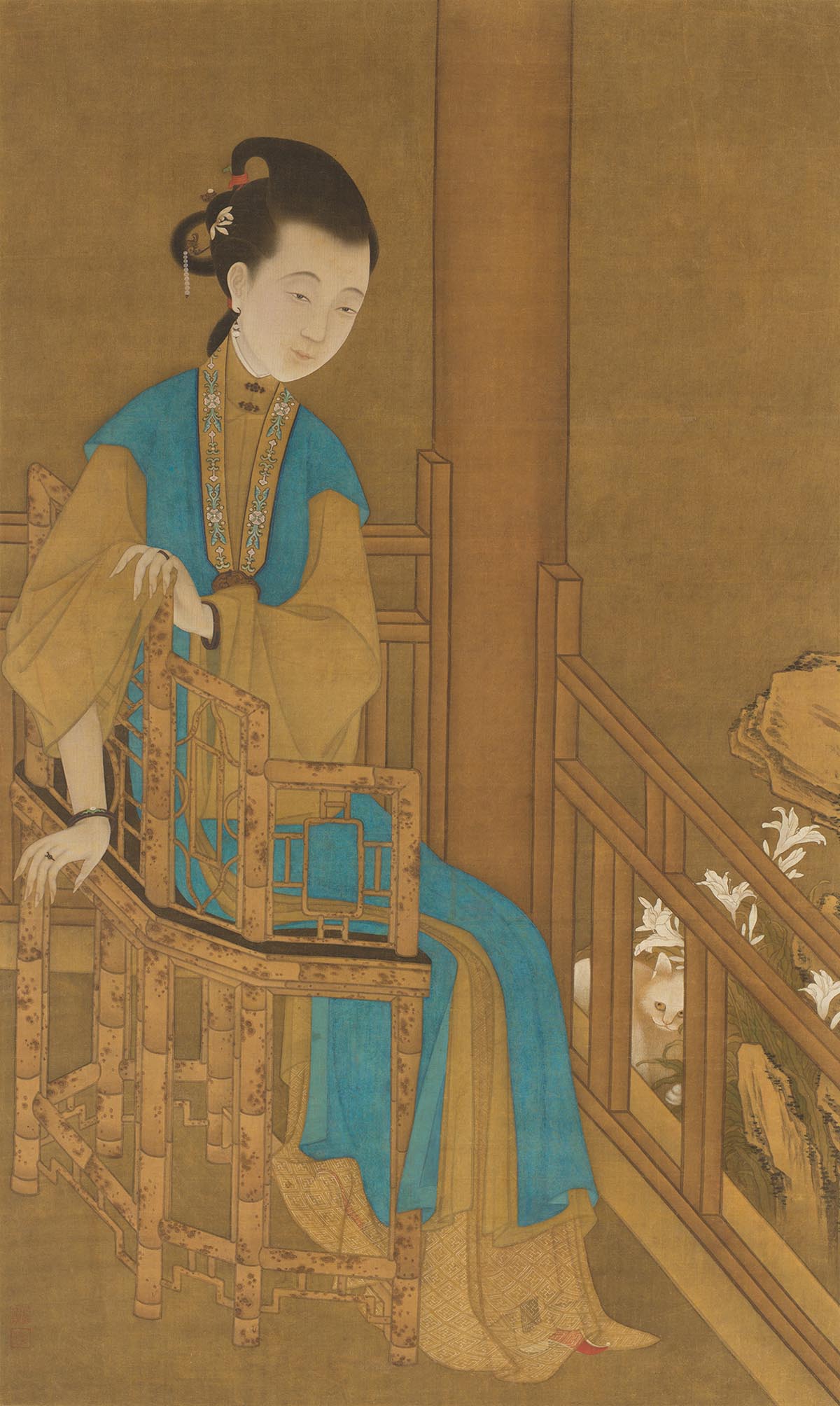
Portrait of a Court Lady, China, Qing dynasty (1644–1911), hanging scroll, ink and color on silk, Museum Purchase, 2013.14
Description
This is the description of the Portrait of a Court Lady in Rediscovered Treasures.
Portrait of a Court Lady is an ink and color on silk hanging scroll. The scroll was made in China during the Qing Dynasty, which lasted from 1644 through 1911. The museum purchased the scroll, and its registration number is 2013.14.
Portrait of a Court Lady is a vertically oriented scroll measuring 107 1/2 by 45 5/8 inches. The scroll depicts a fair-skinned Asian woman seated in a tan hardwood decorative chair with a black seat base. The woman sits outside on a deck next to a railing, her right arm swinging across her body while her right hand is placed on the chair’s backrest, tugging at her left sleeve. She is wearing a long, traditional tan and blue robe, adorned with embroidery around the V neckline. Her facial expression is soft, accompanied by a slight smile. Her hair is styled in sections, secured with red hair ties, and embellished with three decorative hairpins. She accessorizes with white earrings, two black rings, and two black bracelets. Next to the railing, there are a few rocks and white flowers, and a small white cat sits nearby, looking up at her.
Label
This is the label for the Portrait of a Court Lady in Rediscovered Treasures.
The museum acquired this large Chinese portrait painting in 2013. It depicts a court lady sitting on a spotted-bamboo chair in a pavilion. On her left, outside the railing, the artist suggests a garden with rocks, white lilies, and a white cat. According to the curator’s research, this painting likely portrays Lady Nian, the favorite consort of Prince Yinzhen (future Emperor Yongzheng). The curator also suggests that the painter was likely Giuseppe Castiglione (Lang Shining 郎世寧, 1688–1766), the Italian Jesuit painter who entered the Qing court in 1715 and served under three Qing emperors. These findings shed new light on the artist, the subject, and the production date, adding new significance to this imperial portrait and important information on the early works and career of Castiglione as a Qing court painter.
Daoist Immortal Han Xiangzi
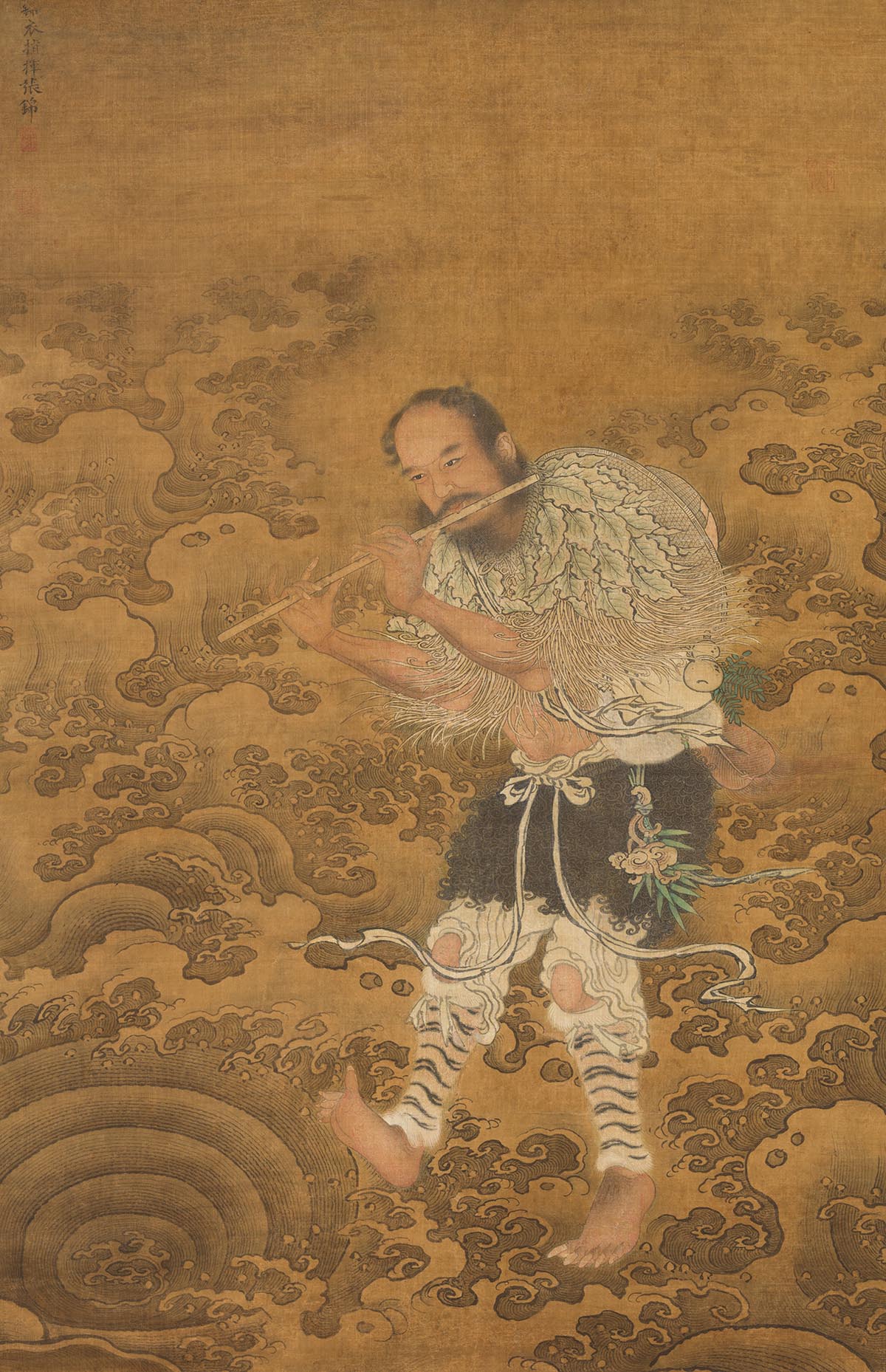
Zhang Jin 張錦 (Chinese, ca. 1450s–1520s), Daoist Immortal Han Xiangzi, late 15th century, hanging scroll, ink and color on silk, Museum Purchase: Gift of the Duke and Duchess of Talleyrand-Perigord, by exchange, 2011.70
Description
This is the description of Daoist Immortal Han Xiangzi in Rediscovered Treasures.
Daoist Immortal Han Xiangzi is an ink and color on silk hanging scroll, created in the late 15th century. The scroll was created by Zhang Jin, a Chinese painter presumed to have been active during the 1450s through the 1520s. The Cincinnati Art Museum acquired this scroll through a gift from the Duke and Duchess of Talleyrand-Perigord. Its registration number is 2011.70.
Daoist Immortal Han Xiangzi is a vertically oriented scroll measuring 92 15/16 by 44 5/16 inches. The background is primarily tan and dark, featuring scattered motifs of turbulent water. In the lower left corner of the scroll, there is a large spinning whirlpool. Near the whirlpool, an adult male walks through the waves, displaying a focused demeanor as he plays his flute. The man has black hair, small bushy eyebrows, a mustache, and a beard. He wears a shawl made of leaves, embellished with long, flowing stems. He has a woven hat draped on his back, and he carries several pouches at his side. The lower half of his attire consists of a flowing white fabric that covers his thighs, topped with a black curly skirt and additional leaves cascading down from his waist. His knees are exposed, and he wears leg warmers with a tiger skin pattern. His feet are bare, slightly hairy, and his toenails are notably long.
Label
This is the label for Daoist Immortal Han Xiangzi in Rediscovered Treasures.
Zhang Jin was a poorly documented painter from the Ming dynasty (1368–1644). His reconstructed biography by Hou-mei Sung from the 1980s includes the dates and ranks of Zhang Jin’s career, as well as those of his father and his great-grandfather, who all served in the Ming court as leading painters. However, even with the reconstructed biographies of the Zhang masters, no existing painting by Zhang Jin was known at the time. Thus, the discovery of this painting in 2011 and its subsequent acquisition for the museum is truly significant.
This painting portrays the Daoist immortal Han Xiang walking across the ocean. Zhang Jin demonstrates his talent by portraying the deity as an intelligent human, rather than following the conventional approach of exaggerating the immortals’ magic-performing narratives. Yet his enlightened state is indicated by his Daoist garb of natural leaves, reeds, and animal skins, and the cosmic rhythms of the rushing waves.
Tapestry
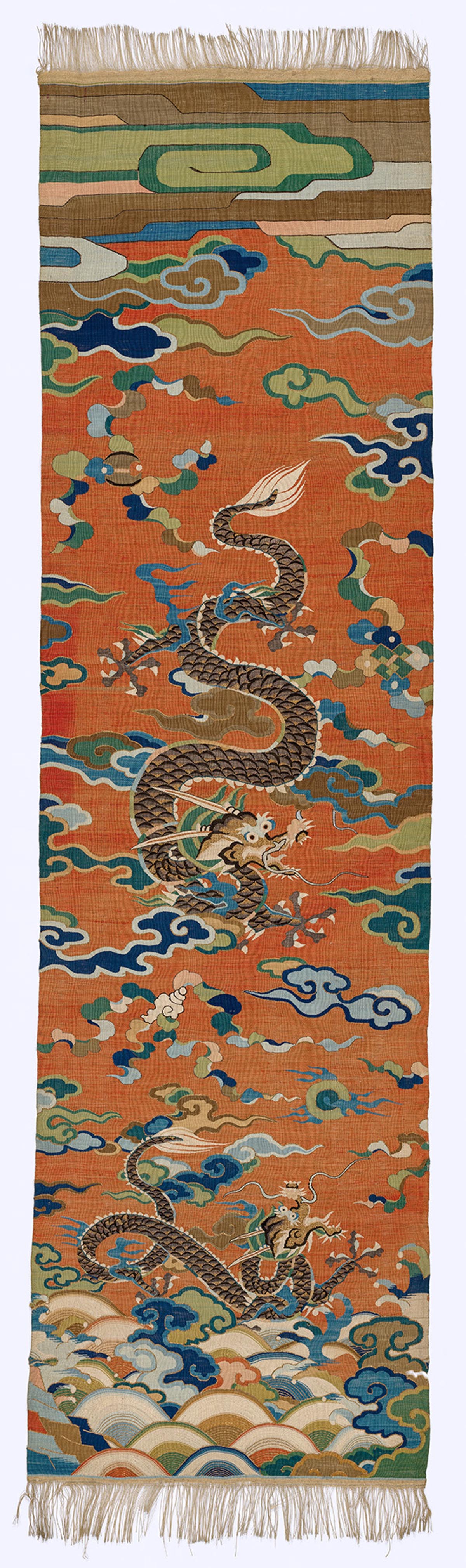
Tapestry, China, 17th century, silk, Lent by Mr. and Mrs. Charles M. Hinkle, L491.1891
Description
This is the description of the Tapestry in Rediscovered Treasures.
Tapestry is a silk textile from China made during the 17th century. This textile was generously given to the Cincinnati Art Museum by Mr. and Mrs. Charles M. Hinkle, and its registration number is L491.1891.
Tapestry is a vertically oriented textile measuring 56 ½ by 14 ½ inches. Depicted in this tapestry are two dragons soaring through the air. Both dragons share a striking resemblance as they are adorned with tannish-brown scales, white tails, long horns, and sharp claws. One dragon is positioned in the center and is larger than the other; its body is long and wavy. This dragon has large eyes that stare at the viewer, and its mouth is slightly open. The second dragon is placed near the bottom of the tapestry, with its mouth open much wider as it looks at the viewer. Its body forms a loop towards the lower part of its torso and near its face and neck. The background of the tapestry is primarily orange, embellished with various colors of abstract clouds scattered throughout.
Label
This is the label for Tapestry in Rediscovered Treasures.
Formerly labeled as Japanese, this tapestry depicts a captivating scene of a large dragon descending from the clouds toward a smaller dragon rising from the waves below. The curator’s research reidentified the tapestry as Chinese and the subject as the established painting theme of 引子朝天龍 (An Old Dragon Leading its Son to Worship Heaven), which first emerged in the fourteenth century. While the depiction of an old dragon accompanied by a young one can be traced to the tenth-century theme of 子母龍 (Mother and Baby Dragons), it was redesigned to convey new political messages in the Ming dynasty (1368–1644). Instead of a realistic depiction of dragons as with the Song theme, the Ming painters created this narrative scene of a large five-clawed dragon, the ruler, coaching the four-clawed young dragon, his son, to rise and worship heaven. The redesigned theme became an ingenious political tool for promoting “emperor worship” advocated in the Ming court.
Amaterasu
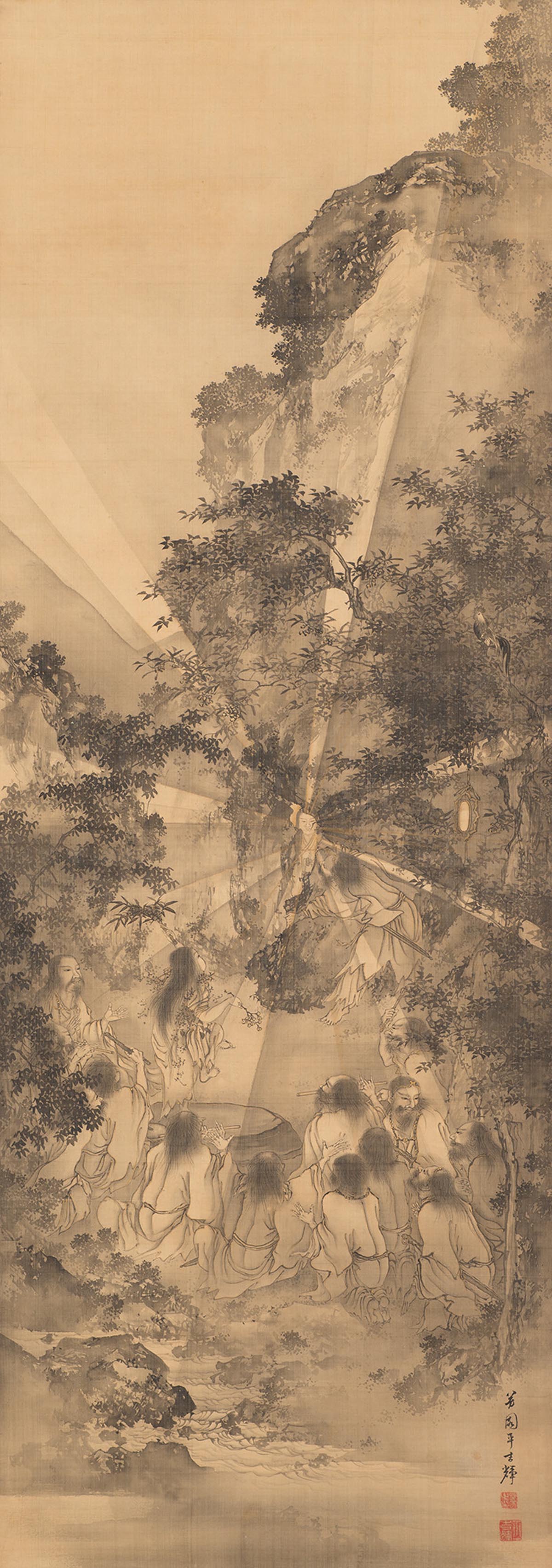
Hōen Yoshiteru 芳園吉輝 (Japanese, active late 19th century), Amaterasu, late 19th century, hanging scroll, ink and color on silk, Gift of Jeanann Gray Dunlap, 2004.1130
Description
This is the description of Amaterasu in Rediscovered Treasures.
Amaterasu is a late 19th-century ink and color on silk hanging scroll by Hōen Yoshiteru, who was a Japanese artist active in the late 19th century. The scroll was gifted to the Cincinnati Art Museum by Jeanann Gray Dunlap, and its registration number is 2004.1130.
Amaterasu is a vertically oriented scroll measuring 92 ¼ by 28 5/16 inches. At the heart of this scroll is a striking divine female figure presented with flowing long hair, a pronounced long nose, straight eyebrows, and small lips. The figure is wearing a robe and clasping something in their hands. Surrounding the figure are multiple golden rays radiating outward. On the left side of the divine figure, a male onlooker attempts to move a large boulder to uncover her. Below him, there are twelve other onlookers, all dressed in white robes and sporting long black hair; most of these onlookers are male and have beards. The scroll is richly adorned with natural elements and landscapes, featuring trees and leaves on both the left and right sides. A mountain is visible in the top right corner of the scroll, while riverways and hills are present in the bottom left. A line of vertically written characters is present in the bottom right corner of the scroll.
Label
This is the label for Amaterasu in Rediscovered Treasures.
This painting, reidentified by the curator as a work by Hōen Yoshiteru, depicts the legend of Amaterasu, the Shinto sun goddess and the mythical ancestor of the Japanese imperial family. According to Japanese mythology, Susanoo, the storm god and brother of Amaterasu, ravaged the earth, so upsetting Amaterasu that she retreated into a cave, plunging the world into darkness. To lure her out, the other deities gathered outside the cave and organized a program of wild entertainment. Hearing this and growing curious, Amaterasu peeked out and another deity pulled her from the cave, restoring light to the world. Hōen dramatically captures this moment with a masterful use of ink and the strategic placement of yellow-gold pigment, as Amaterasu’s body is half-revealed and her rays of light burst out from the cave.
Sumo Apron
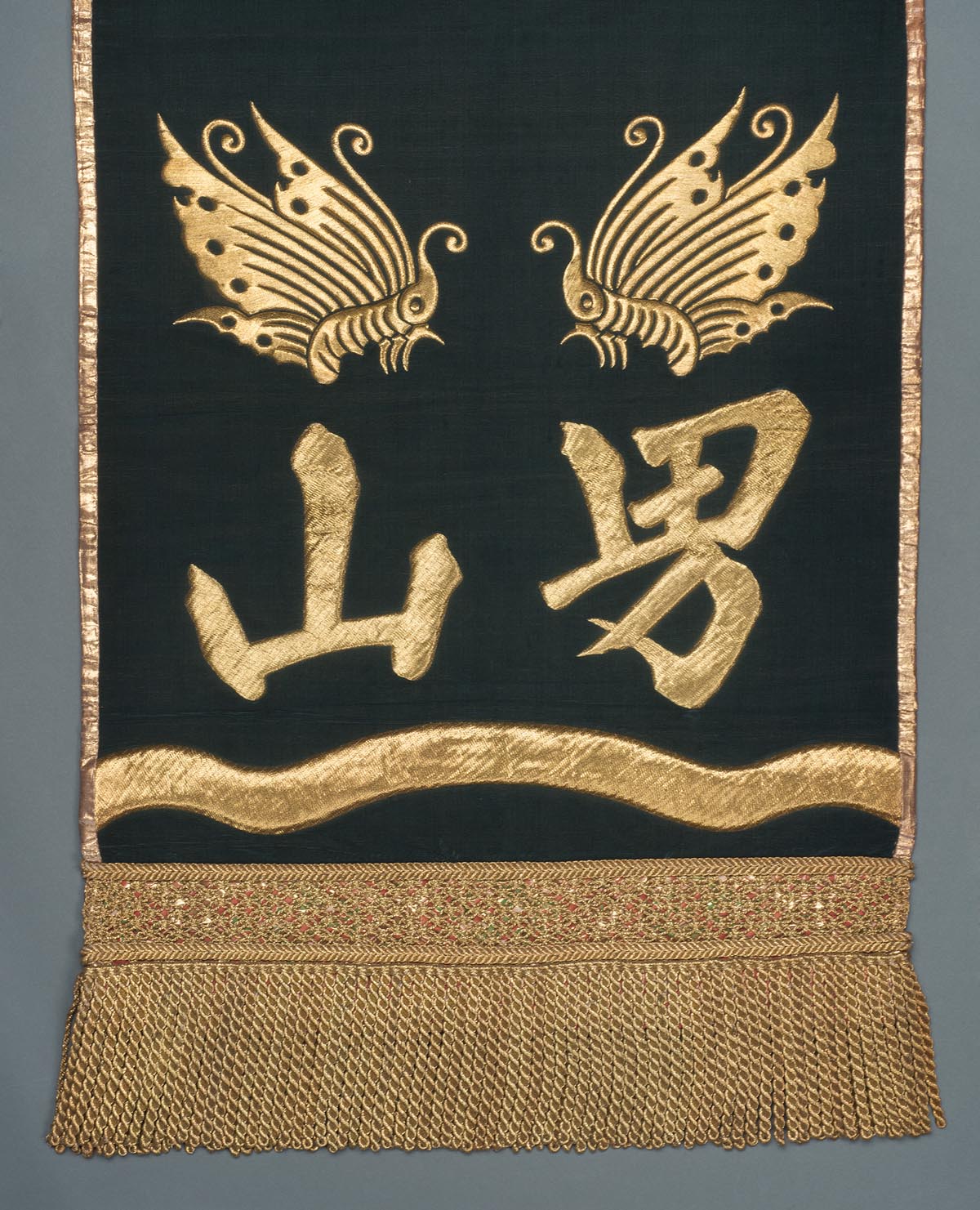
Sumo Apron, Japan, Meiji period (1868–1912), silk embroidery, Lent by Mr. and Mrs. Charles M. Hinkle, L496.1891
Description
This is the description of the Sumo Apron in Rediscovered Treasures.
Sumo Apron is a silk embroidery from Japan made during the Meiji period, which lasted from 1868 through 1912. This embroidery was generously given to the Cincinnati Art Museum by Mr. and Mrs. Charles M. Hinkle, and its registration number is L496.1891.
Sumo Apron is a vertically oriented textile measuring 257 ½ x 27 ½ inches. The silk embroidery has a primarily blue background with two golden butterflies facing each other near the top. Below the butterflies are two golden written characters, and a slightly wavy line is placed underneath the letters. The end of the tapestry has multiple twisted and flowing tassels.
Label
This is the label for the Sumo Apron in Rediscovered Treasures.
Mawashi (廻し) is a long, thick fabric folded and wrapped to form a loincloth worn by Japanese sumo wrestlers. During the Edo period (1615–1868), the mawashi worn by higher-ranked wrestlers typically included a large silk apron decorated with embroidery and tassels.
This mawashi, made of dark blue silk, is decorated with two embroidered golden butterflies on top of two large Japanese characters, 男山 (Otokoyama).
In 2024, the curator discovered that this apron belonged to 男山應輔 Oyama Osuke (Otokoyama Osuke) (1864–1886), a promising young sumo wrestler from Hiki (Saitama). In 1886, a tragic accident in Nagano seriously injured Osuke and cut his career short. Adding to the significance of this discovery is a print created by artist Utagawa Kuniaki II (1835–1888) memorializing Osuke wearing his apron.
Buddha with Pupils
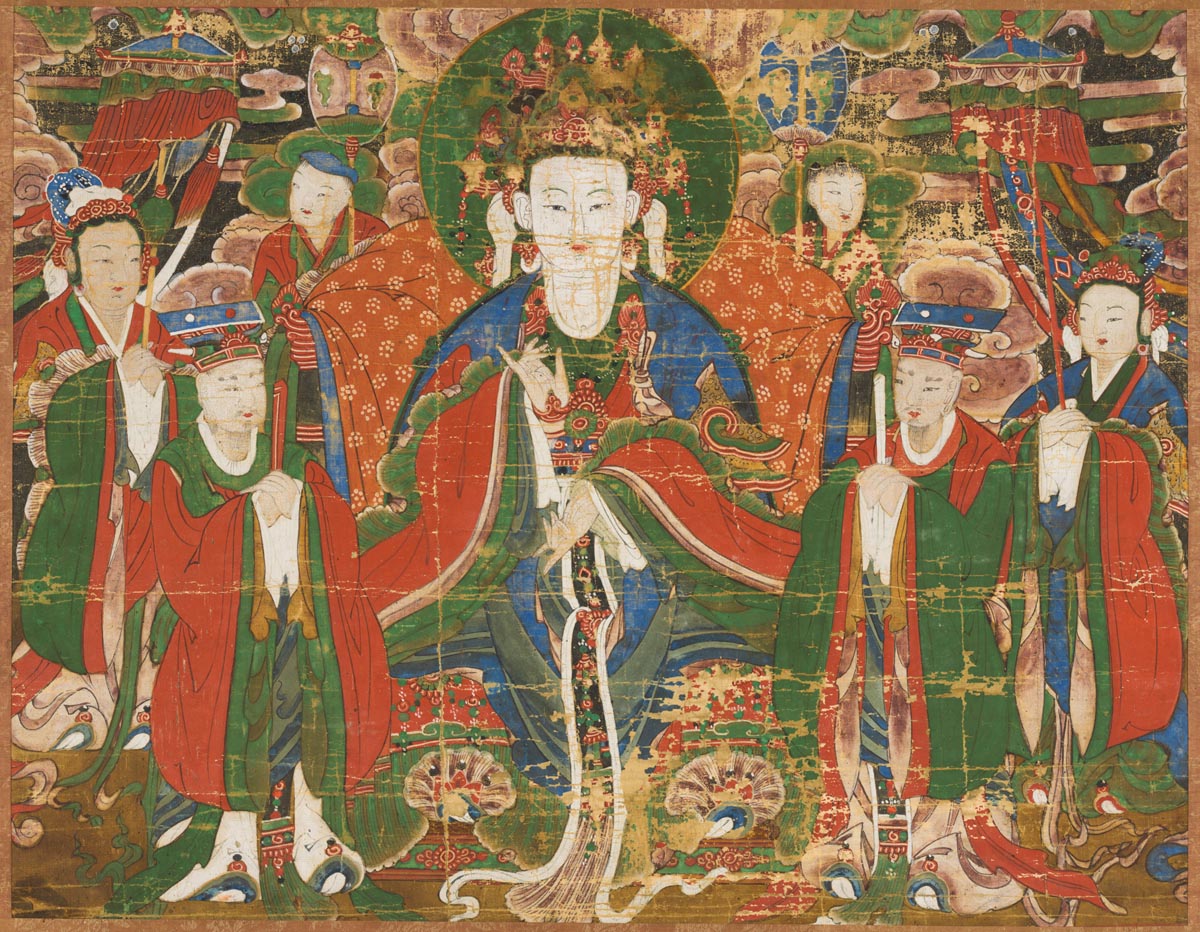
Buddha with Pupils, Korea, 18th century, ink and color on silk, Gift of Dr. Martin Fischer, 1957.382
Description
This is the description of Buddha with Pupils in Rediscovered Treasures.
Buddha with Pupils is an ink and color on silk from Korea made during the 18th century. This painting was given to the Cincinnati Art Museum by Dr. Martin Fischer. Its registration number is 1957.382.
Buddha with Pupils is a horizontally oriented painting measuring 32 by 36 ½ inches. This vibrant scene depicts a Buddhist deity seated and surrounded by six attendants. The deity occupies the center of the piece, sitting on a chair covered with a red cloth featuring small white dots that form a floral pattern. They have a soft and gentle facial expression, characterized by slightly curved eyebrows, small circular red lips, and eyes that keep contact with the viewer. The deity wears a red headpiece, and behind their head is a large green circle. They are adorned in a blue robe with red and green sleeves, and the robe features a long decorative sash in the middle that flows down to the bottom of the artwork. The deity's hands are positioned close to their chest; the right hand is raised towards the sky, while the left hand faces downward. On both sides of the deity are three pairs of pupils, each wearing different variations of blue, red, and green robes. The two attendants closest to the viewer are gazing at the deity and are holding court tablets. The attendants in the middle, also looking at the Buddha, hold long dowels topped with flowing decorative fabrics. The last two attendants, farthest from the viewer, are facing away from the Buddha and are carrying tall fans.
Label
This is the label for Buddha with Pupils in Rediscovered Treasures.
The painting Buddha with Pupils entered the museum’s collection in 1957 as a Chinese painting of the sixteenth century. Unmounted and in poor condition, the painting has never been displayed. In 2019, the curator, after extensive research, changed the attribution from a Chinese Ming dynasty (1368–1644) Buddhist painting to a Korean Joseon dynasty (1392–1910) painting. She also identified the principal deity here as the Hindu god Indra (Śakro devānām indrah), who gained increasing popularity in temple painting after the Joseon rulers adopted Confucianism as the national philosophy and turned away from Buddhism. This change in patronage caused many Buddhist temples to relocate to rural areas and prompted the emergence of a new type of Buddhist painting known as sinjung taenghwa (a host of spirits hanging painting). Composed of many minor deities and guardian figures from diverse religions, sinjung taenghwa drew on Hinduism, Chinese Buddhism and Daoism, and Korean folk traditions, as depicted here.
Bowl
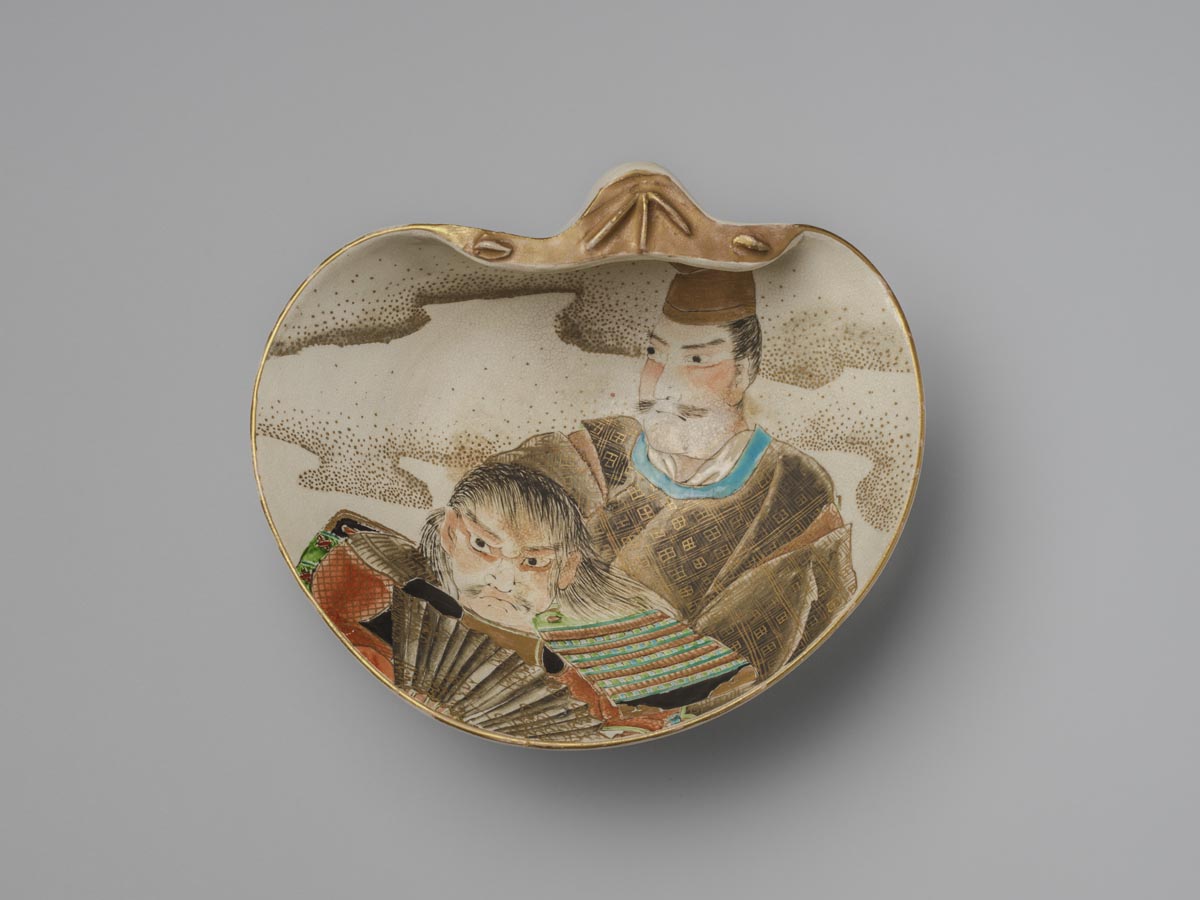
Bowl, Japan, late 19th century, porcelain, Gift of Mrs. Harriet Muscroft, 1888.212
Description
This is the description of the Bowl in Rediscovered Treasures.
This is a porcelain Japanese bowl, created in the late 19th century. Bowl was given to the Cincinnati Art Museum by Mrs. Harriet Muscroft. Its registration number is 1888.212.
Bowl is a porcelain ceramic measuring three by seven and one-half inches. The focal point of this piece is the two men present. The man on the left has a distinct facial expression; his eyebrows are furrowed, and his nose is scrunched up. He appears alert and focused on his surroundings as he gazes slightly outward to the left side of the bowl. He is holding a detailed folding fan near his chest, which covers most of the orange robe he is wearing. The man on the right has a more subdued and serene expression. He is wearing a brown cap and a brown robe featuring a diamond pattern, topped with a blue collar. He is holding a green and brown rectangular object. The background consists of two swirling lines and numerous dots that flow throughout the sky. The bowl's edges are uneven and rounded.
Label
This is the label for the Bowl in Rediscovered Treasures.
This shell-shaped ceramic work, likely a nineteenth-century Kutani export ware, is decorated on the interior surface with a painting featuring a Japanese warrior and a court official. After research, the curator identified the two figures as Minamoto no Yoshitsune (1159–1189) and Minamoto no Yoritomo (1147–1199), the two legendary heroes of the Minamoto clan during the late Heian (794–1185) and early Kamakura (1185–1333) periods. The figure in the front wearing samurai armor and holding a fan is Yoshitsune, the great warrior who helped his half-brother Yoritomo consolidate power. Behind him, wearing a court hat and gold-patterned robe, is Yoritomo. The shape and subject of this ceramic work are both rare and interesting.
Jingasa
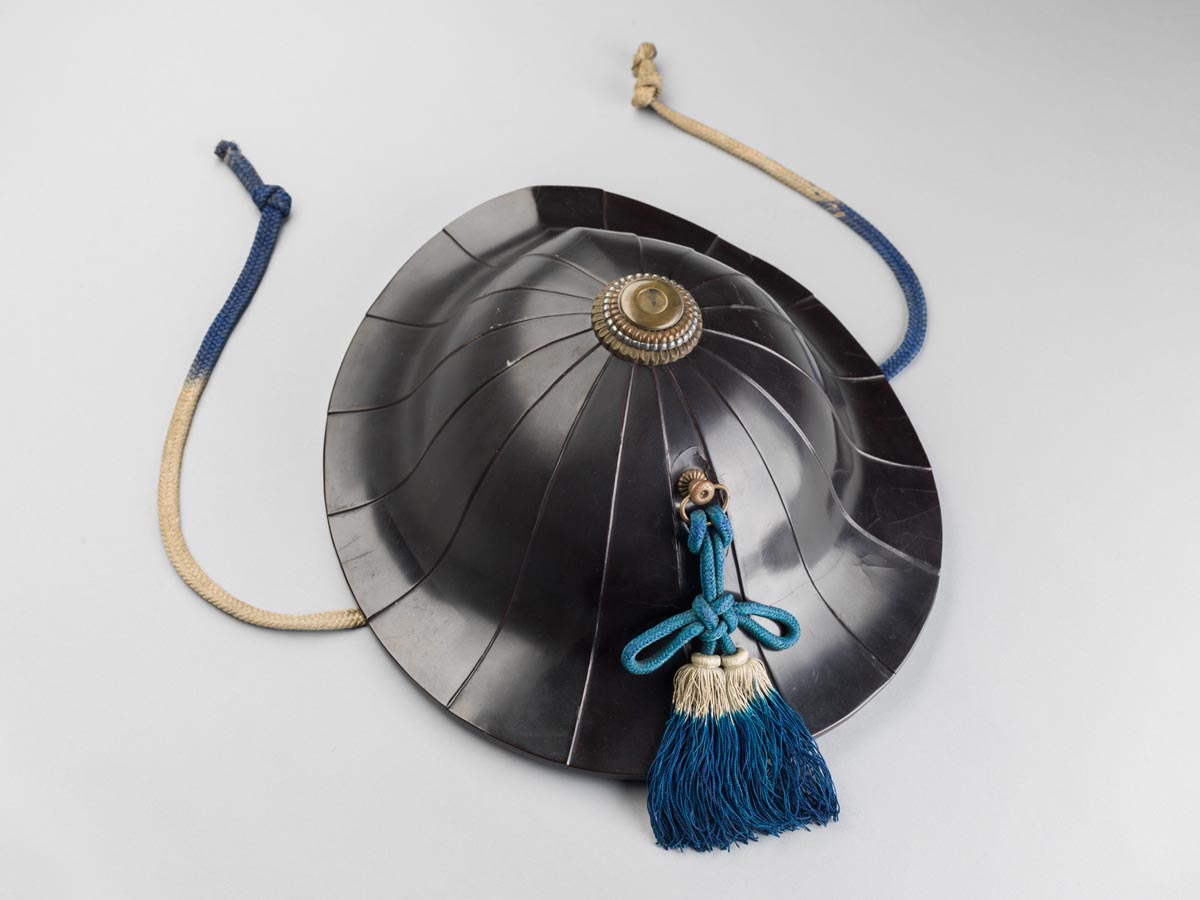
Jingasa, Japan, Edo period (1615–1868), lacquer, wood, Lent by Mr. and Mrs. Charles M. Hinkle, L497.1891
Description
This is the description of Jingasa in Rediscovered Treasures.
Jingasa is a lacquer and wood headpiece from Japan made during the Edo period, which lasted from 1615 through 1868. Jingasa was generously given to the Cincinnati Art Museum by Mr. and Mrs. Charles M. Hinkle, and its registration number is L497.1891.
Jingasa is a traditional conical hat from Japan, measuring 5 1/2 x 12 1/4 x 13 5/8 inches. It features a primarily black outer shell embellished with multiple straight lines. Attached to the sides of the hat are blue and white multi-colored ropes. At the top of the hat is a four-tiered metal fixture. The back of the Jingasa has a blue knotted rope; attached to the end of this rope are two multi-colored tassels. The top half of the tassel is white, and the bottom half is blue.
This is the label for Jingasa in Rediscovered Treasures.
The East Asian curator discovered this wooden hat in 2014 while working on the exhibition Dressed to Kill: Japanese Arms and Armor. Formerly listed in the curatorial records as a “judge’s hat,” this jingasa (Japanese warrior’s hat) is made of wood and beautifully lacquered in black on the exterior and red on the interior. The lacquer coating creates a waterproof and durable finish. A finely crafted metal decorative cap, shaped like a chrysanthemum blossom, adorns the top of the helmet. A small gilt ring on the back of the hat holds an elegant blue agemaki (decorative knot).
Fan
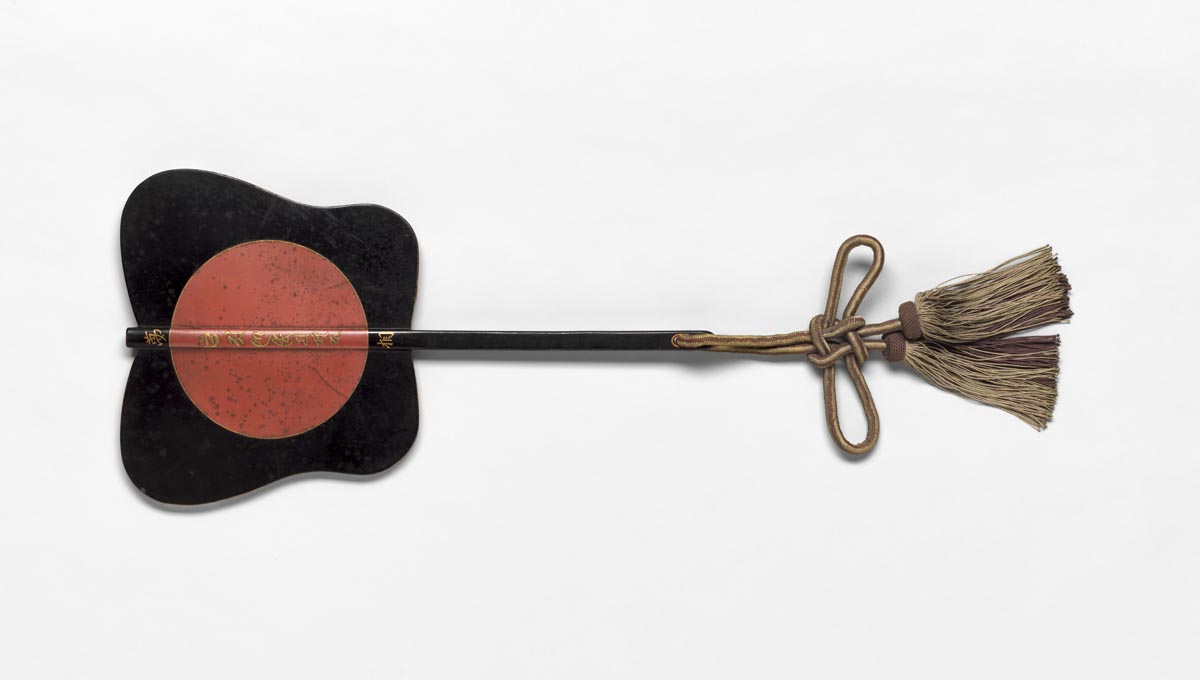
Fan, Japan, 19th century, lacquer, Lent by Mr. and Mrs. Charles M. Hinkle, L498.1891
Description
This is the description of the Fan in Rediscovered Treasures.
This is a Japanese lacquer fan made during the 19th century. This fan was generously given to the Cincinnati Art Museum by Mr. and Mrs. Charles M. Hinkle, and its registration number is L498.1891.
Fan is a horizontally oriented decorative art object, measuring 30 13/16 by 10 13/16 inches. The leaf of the fan is butterfly-shaped with rounded edges. It is primarily black, featuring a large red circle in the center that occupies most of the leaf. The handle of the fan is also black and is connected to a golden knotted rope, which has two flowing tassels.
Label
This is the label for the Fan in Rediscovered Treasures.
The curator recently identified this lacquered wooden fan as an early gunbai 軍配 (military fan), which samurai officers traditionally used to communicate commands to their troops.
The fan is decorated on the front with a red circle and a gold Sanskrit inscription on the upper handle. On the back, the decoration consists of a gold circular band marked with the Chinese astrology chart of the 28 lunar mansions (二十八宿). The chart, based on the ancient Chinese constellations system, was often used to determine the dates for important events and predict their outcomes. On the handle are seven characters: 南無摩利支尊天, the Chinese/Japanese name of Mārīcī, the Buddhist deity associated with the sun and adopted by the samurai as a protector.
Buddhist Praying Mirror
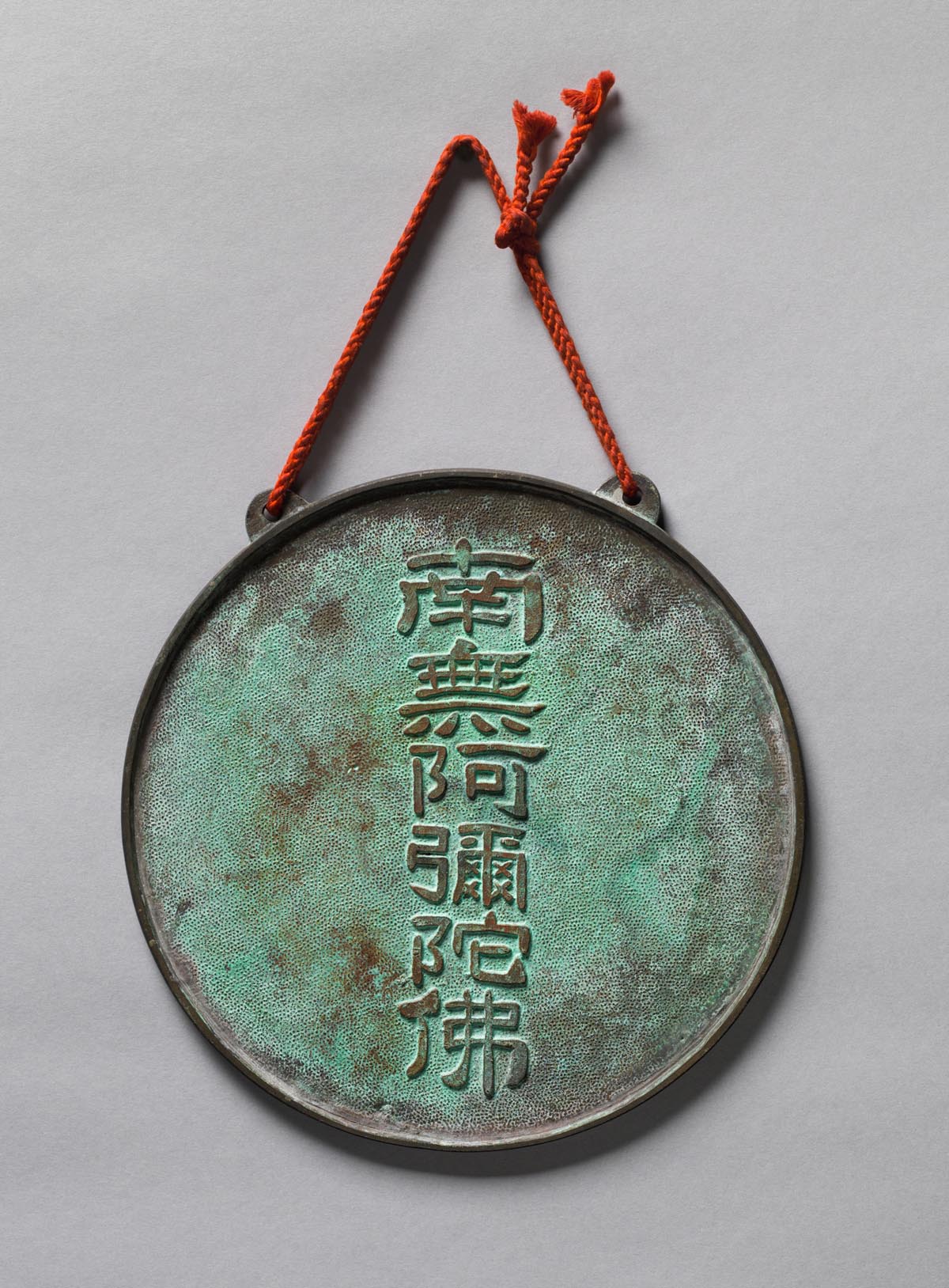
Buddhist Praying Mirror, Japan, 14th–15th century, bronze, Source Unknown, x1961.2
Description
This is the description of the Buddhist Praying Mirror in Rediscovered Treasures.
Buddhist Praying Mirror is a bronze mirror made in Japan during the 14th-15th century. This mirror was given to the Cincinnati Art Museum in the early 20th century, and its registration number is x1961.2.
Buddhist Praying Mirror is a circular bronze piece with a diameter of eight ½ inches. The mirror features a predominant green and brown hue. Six characters are written down vertically in the center of the mirror. The mirror is attached to a bright orange knotted rope used for carrying or hanging the mirror.
Preserving Legacies
This section highlights CAM’s endeavors to conserve East Asian paintings and objects over the past two decades. The artworks on display chronicle the history of the museum’s Asian art conservation and showcase the unique conservation techniques required to conserve these objects.
The museum is deeply indebted to the Jeanann Gray Dunlap Foundation, which has generously supported the Asian department’s research and conservation needs for 20 years—from 2004 to 2024—and restored a total of 39 Chinese and Japanese paintings, including many rare masterpieces. The museum is also fortunate to have received support for Asian painting conservation from the Institute of Museum and Library Services, the Carpenter Foundation, the Cincinnati Asian Art Society, the Tokyo National Research Institute for Cultural Properties, and several local individual donors.
Female Immortal and Crane
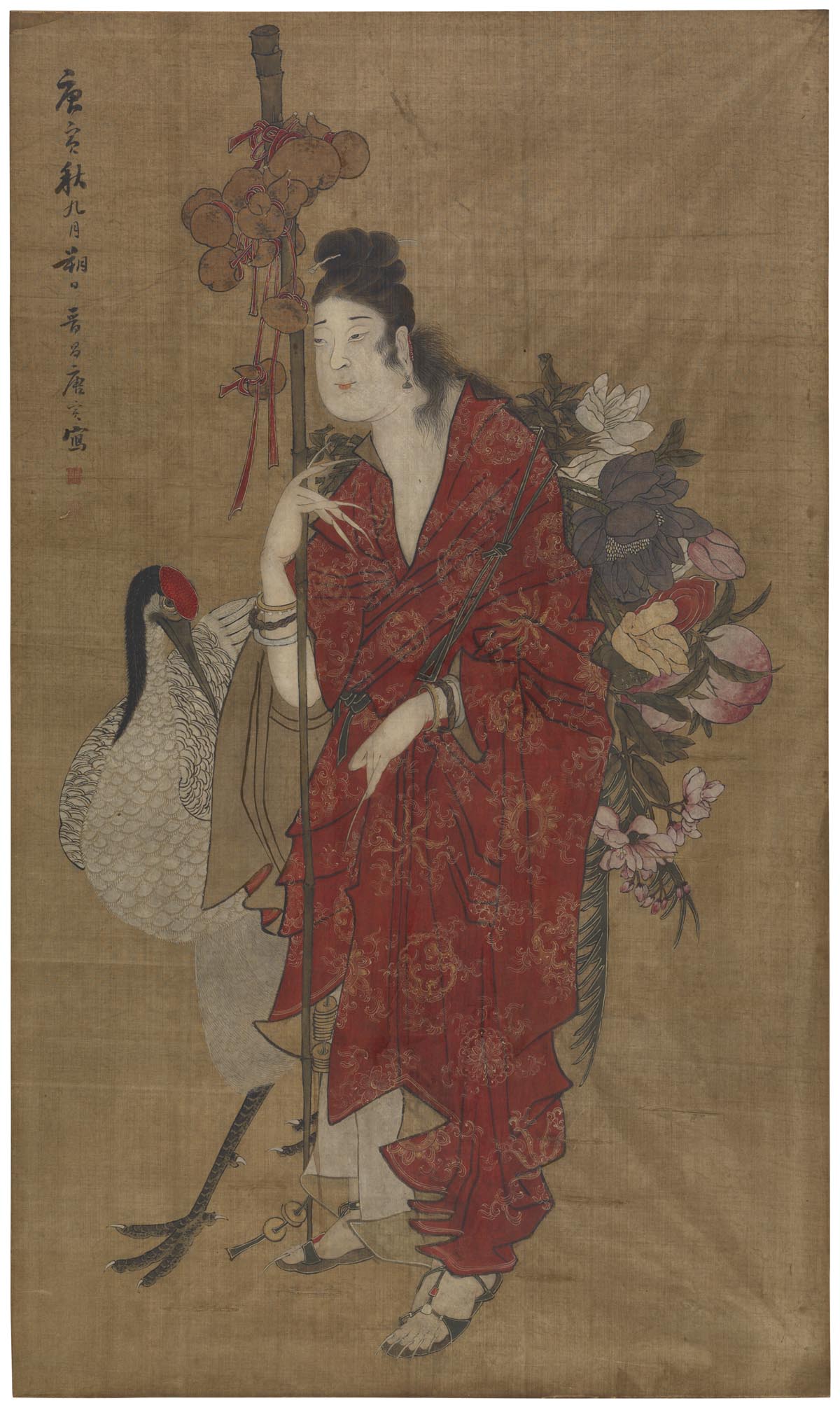
Female Immortal and Crane, China, Ming dynasty (1368–1644), hanging scroll, ink and color on silk, Gift of Dr. Martin Fischer, 1957.383
Description
This is the description of the Female Immortal and Crane in Rediscovered Treasures.
Female Immortal and Crane is an ink and color on silk hanging scroll. The scroll was created in China during the Ming dynasty, which lasted from 1368 through 1644. The scroll was given to the Cincinnati Art Museum by Dr. Martin Fischer, and its registration number is 1957.383.
Female Immortal and Crane is a vertically oriented hanging scroll that measures 110 by 30 inches. The scroll features a woman and a crane set against a tan, bare background. The woman wears a red robe adorned with numerous floral and nature motifs; the interior of her robe is brown, and she wears white pants underneath. She accessorizes with earrings, bracelets, and brown sandals. Notably, her fingernails and toenails are very long. Her hair is black and styled in an updo, secured by a stick, with some strands hanging loose in the back. She has a rounded face with small orange lips, a long nose, and straight eyebrows. Her expression is neutral, and her eyes gaze out towards the left side of the scroll. In her hand, she carries a long staff, from which several gourds are tied together at the top. On her back, she carries various large and vibrant flowers. To her left, a crane makes its presence known with its sharp gaze directed at the viewer. The bird's feathers are primarily white, and it has a long black beak and a red crown. A line of vertically written characters is present on the top left side of the scroll.
Label
This is the label for the Female Immortal and Crane in Rediscovered Treasures.
This painting was formerly titled Flower Girl and attributed to Tang Yin 唐寅 (1470–1523), a Ming dynasty (1368–1644) painter known for depicting female figures. However, judging from the large size of the portrait, the fashion of the costume and accessories, and the painting style, the curator believes this is more likely a Qing dynasty (1644–1911) work. In addition, the female figure, wearing a beautiful gold flower-patterned red robe, accompanied by a crane, holding a cane tied with numerous gourds, and carrying bunches of flowers and a large peach on her back, is most likely depicting He Xiangu 何仙姑, a female member of the Daoist Eight Immortals. The image of He Xiangu underwent a significant transformation in the late Ming and Qing dynasties due to the influence of popular dramas. However, the newly attributed date and subject of this hanging scroll match well with the image of the female immortal.
Guan Yu on Horseback
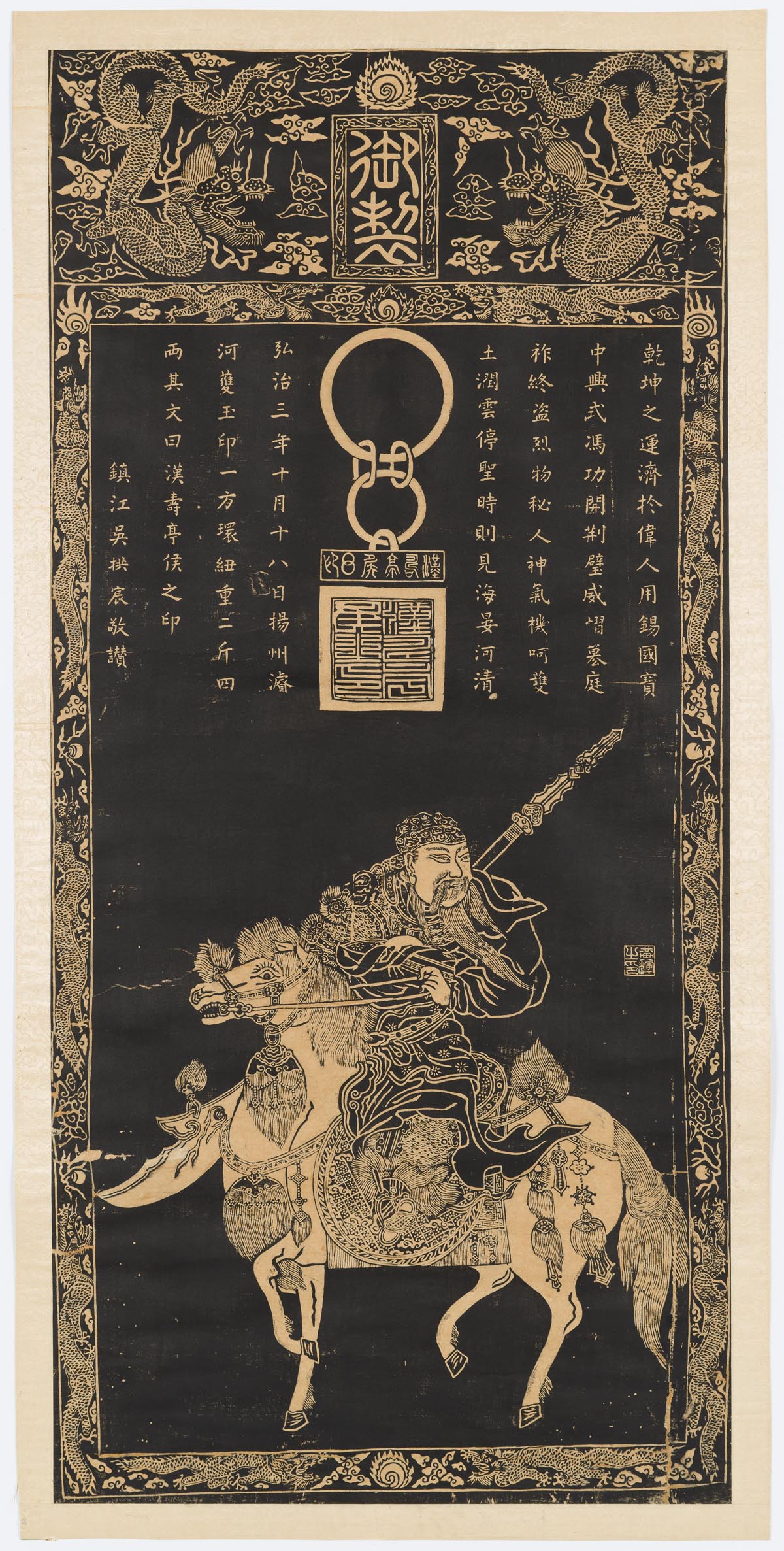
Guan Yu on Horseback, China, Ming dynasty (1368–1644), hanging scroll, ink on paper, Gift of Lucille Dixon, 2019.300
Description
This is the description of Guan Yu on Horseback in Rediscovered Treasures.
Guan Yu on Horseback is an ink on paper hanging scroll made in China during the Ming Dynasty, which lasted from 1368 through 1644. This scroll was given to the Cincinnati Art Museum by Lucile Dixon, and its registration number is 2019.300.
Guan Yu on Horseback is a vertically oriented scroll measuring 85 ¼ by 29 inches. In the center of this scroll, a male figure is riding a white horse. He sports a single-colored robe adorned with a floral or sun-like pattern near his waist, along with a decorative shoulder piece. A large polearm is visible on his back. The horse he rides is equipped with a highly detailed saddle and bridle, as well as a harness embellished with flowing tassels. The horse appears alert, with wide-open eyes focused on the viewer. Its mouth is open, revealing its teeth, and it stands tall with its right foreleg and left hind leg slightly raised. Above the horse and the rider, there are eight vertical lines of Chinese characters. A large, stamped seal with two rows of three seal script characters sits between them, suspended by two prominent rings. The background of this scene is black, framed by a detailed border featuring dragons and natural elements. At the top of the scroll, a rectangular section connected to the border displays two dragons facing each other. Between them, two vertically written characters are enclosed in a border decorated with cloud motifs.
Label
This is the label for Guan Yu on Horseback in Rediscovered Treasures.
This is an ink rubbing taken from a stone stele. After identifying the subject as Guan Yu 關羽 (162–219), a military general of the late Eastern Han dynasty (25–220), the curator conducted further research on the unique significance of this rubbing.
Throughout Chinese history, numerous portraits of Guan Yu have been documented on carved stone tablets. Unfortunately, most of these early tablets survive today only through later rubbings. This rubbing is from a tablet erected in the early Ming dynasty (1368–1644) through imperial sponsorship. According to the inscription on the tablet, it was erected in the third year of the Hongzhi reign (1490), when a large jade seal, marked with the inscription “漢壽亭候之印” (“seal of the Marquis of Hanshouting”) was discovered during the unclogging of a river in Yangzhou, Jiangsu. Since Hanshoutinghou was once the official title of Guan Yu, the court celebrated the discovery with this tablet.
Conservation:
The rubbing came to the museum in a frame sandwiched between glass and acidic cardboard. Conservation treatment included removing the degraded lining papers and washing the rubbing to flush out acid degradation products and discoloration. The conservator mounted the rubbing as a Chinese hanging scroll.
Presentation of a Prince
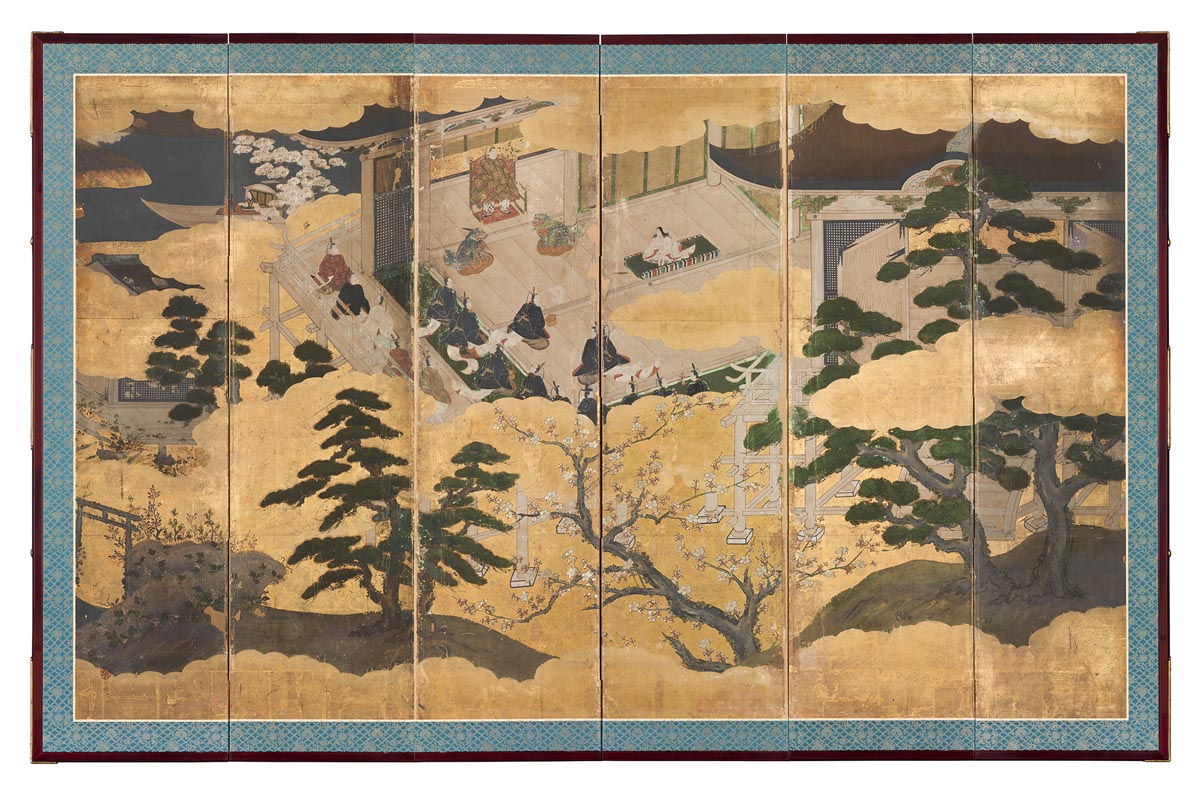
Attributed to Chiyo Mitsuhisa 千代光久 (Japanese, active late 16th century), Presentation of a Prince, six-fold screen, ink, color, and gold on paper, The Thoms Collection; given by Mrs. Murat H. Davidson in Honor of her Grandfather, Joseph C. Thoms, 1982.6
Description
This is the description of the Presentation of a Prince in Rediscovered Treasures.
Presentation of a Prince is a six-fold screen done in ink, gold, and color on paper. The six-fold screen is attributed to Japanese artist Chiyo Mitsuhisa, who was active during the late 16th century. The screen was made during the 17th century. The screen is from The Thoms Collection and was given to the Cincinnati Art Museum by Mrs. Murat H. Davidson in Honor of her grandfather, Joseph C. Thoms. Its registration number is 1982.6.
Presentation of a Prince is a horizontally oriented work on paper measuring 41 5/16 by 66 15/16 inches. The painting depicts a prince being showcased to the emperor inside a palace. The emperor is positioned towards the top of the third screen; he wears a golden robe, is seated on a red throne, and has two animal statues in front of him. The emperor gazes at the scene unfolding before him. To his left, the prince is shown with long black hair, wearing a white robe with hints of red. He kneels on a green mat, looking at the emperor's royal servants. On the right side of the emperor, several royal servants are present, all adorned in dark blue robes and hats. The servants are looking in various directions; some gaze at the prince, others engage with one another, while a few face the emperor. In the second screen, behind the royal servants, other onlookers can be seen wearing robes of an assortment of colors. This scene occupies the upper center of the painting, with the surrounding background primarily featuring trees, land, clouds, and architectural elements that represent the outside elements of the temple. In the upper right corner, a boat and riverway are also visible.
Label
This is the label for the Presentation of a Prince in Rediscovered Treasures.
In 2002 when the curator discovered the attribution of this unsigned screen to Chiyo Mitsuhisa, she realized its importance and made it a focus of her research. Chiyo was the daughter of Tosa Mitsunobu (1434–1525), the founder to Tosa school, and wife of Kanō Motonobu (1476–1559), leading master of the Kano school.
In this screen depicting a scene from the Tale of Genji, the artist departs from the earlier tradition established in the sixteenth century by revealing the emperor’s face instead of obscuring it behind a bamboo blind. However, the composition and many motifs still follow those established by Tosa Mitsunobu, Chiyo’s father. Judging from the screen’s close association with the style of Tosa Mitsunobu, the curator believes that this screen may indeed be a rare work by Chiyo Mitsuhisa. This research also led to the support from the Tokyo National Research Institute for Cultural Properties for its conservation.
Conservation:
The museum sent this screen to the Tokyo National Research Institute for Cultural Properties for conservation for conservation in 2012, where conservators cleaned, repaired, and remounted it. They also removed the previous retouching and, rather than recreating the original design with inpainting, filled the losses with paper toned with a neutral color, which remains visible.
Dancing Horse
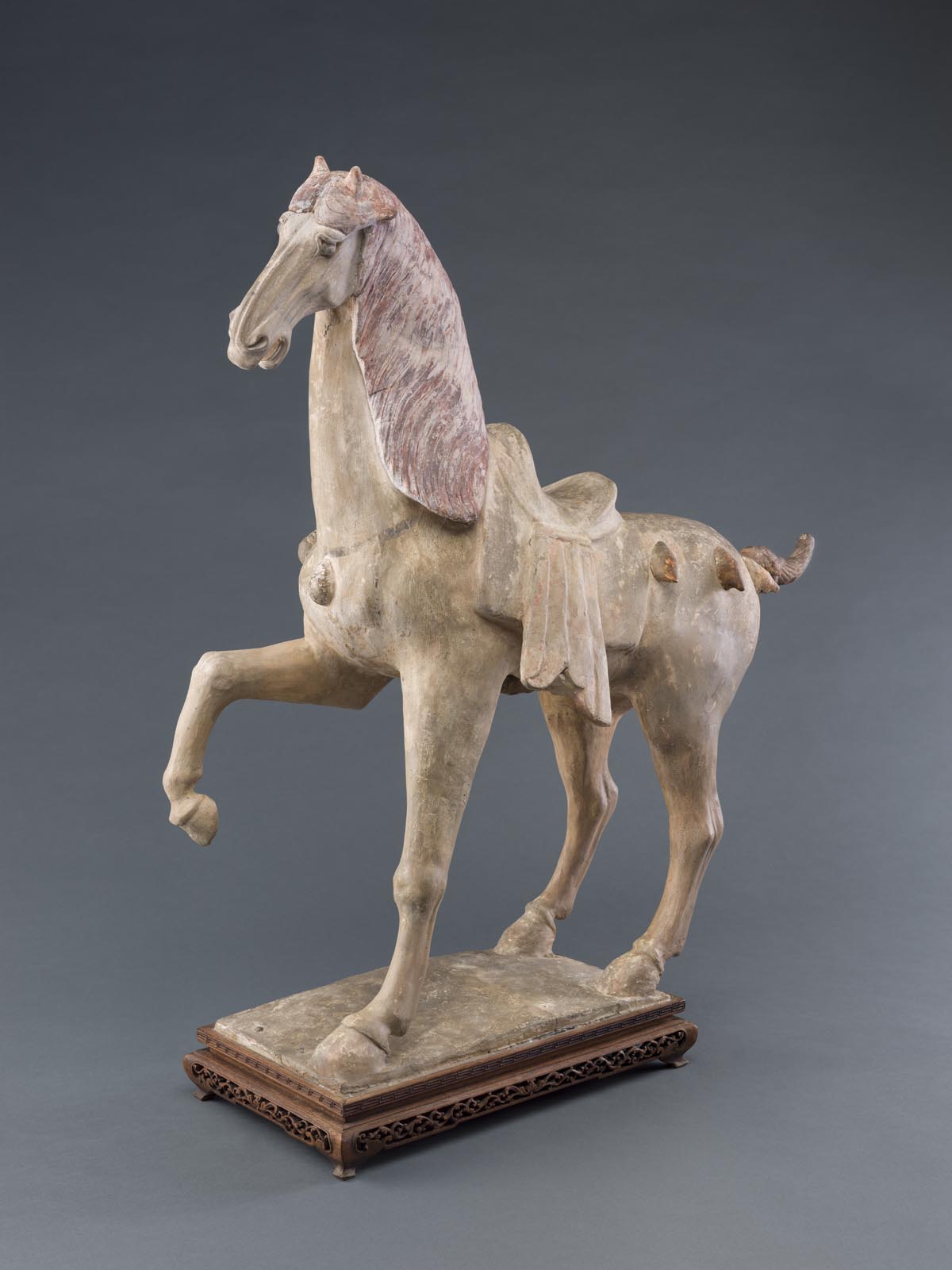
Dancing Horse, China, Tang dynasty (618–907), earthenware with unfired pigments, Gift of Carl and Eleanor Strauss, 1997.53
Description
This is the description of the Dancing Horse in Rediscovered Treasures.
Dancing Horse is a Chinese ceramic made of earthenware with unfired pigments. This ceramic was made during the Tang Dynasty, which lasted from 618 through 907. Dancing Horse was gifted to the Cincinnati Art Museum by Carl and Eleanor Strauss, and its registration number is 1997.53.
Dancing Horse is a horizontally oriented ceramic that stands 26 ½ inches tall. It features a desert sand-colored horse positioned on a dark brown rectangular platform. The horse's mane has a reddish-pink hue, while its small, slightly curled tail is a darker tan color. The horse stands tall with its right foreleg raised in the air. Its face is long and displays a happy expression, with its mouth slightly open in a smile. The horse is accessorized with a saddle and a decorative harness.
Label
This is the label for the Dancing Horse in Rediscovered Treasures.
Dancing horses were introduced into China from Cen-tral Asia as early as the Han dynasty (206 BCE–220 CE) and developed into a popular form of entertainment during the fifth century. This horse’s stance, with one leg raised, as well as the harness with tassels, neatly groomed mane and tail, and finely crafted saddle, indicate its status as an imperial dancing horse.
In 2020, the curator noticed that the tassel on the horse’s forehead was inconsistent with Tang horse fashion. This led to further investigation with the museum’s Conservator of Objects and found that it was not a part of the original artwork.
Bowl with Shell Attachments
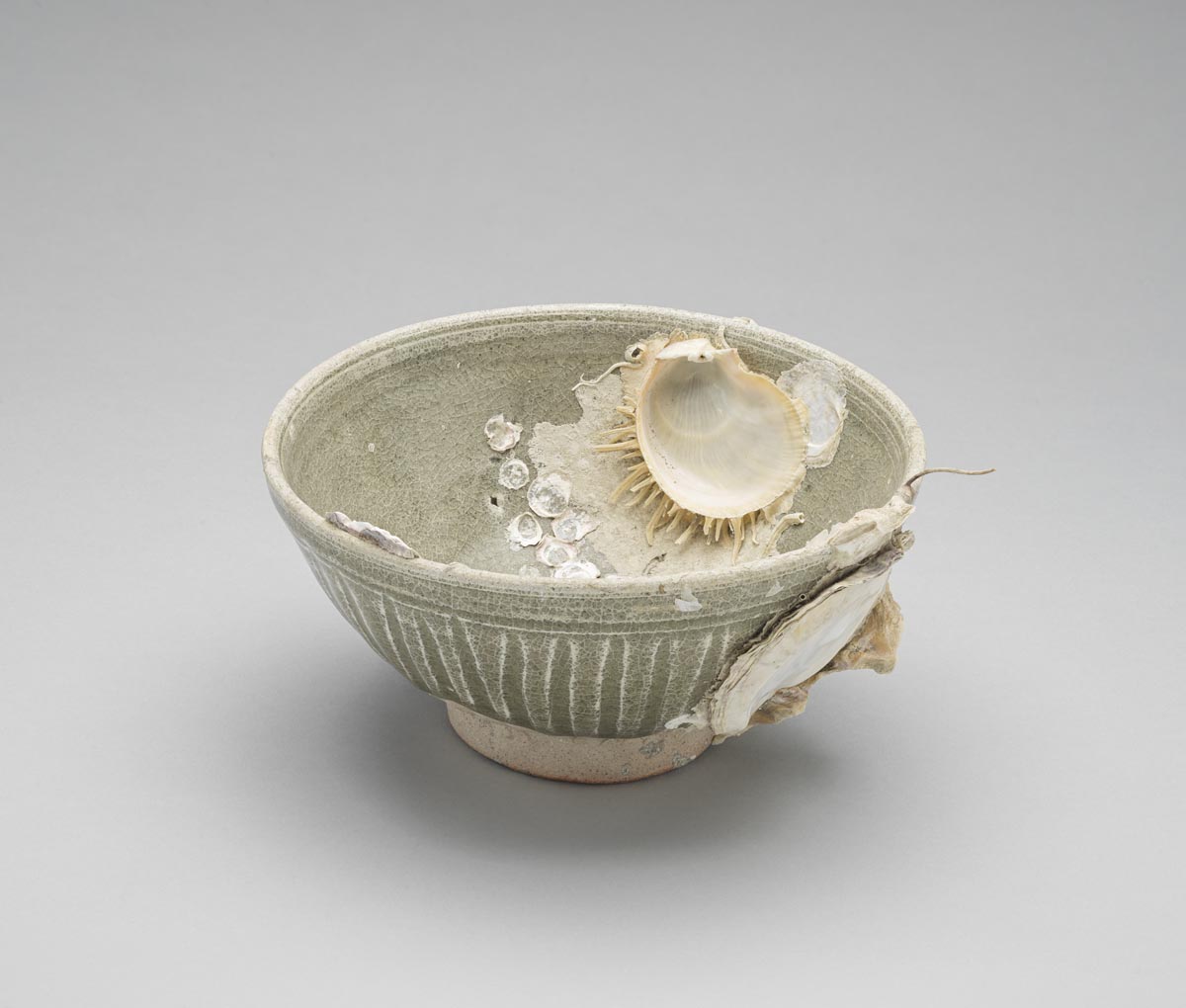
Bowl with Shell Attachments, Thailand, 13th century, Sawankhalok ware, Gift of Widodo Latip, 2019.208
Description
This is the description of the Bowl with Shell Attachments in Rediscovered Treasures.
Bowl with Shell Attachments is a 13th-century Sawankhalok ware bowl from Thailand. The bowl was given to the museum by Widodo Latip, and its registration number is 2019.208.
Bowl with Shell Attachments is a rounded piece of Sawankhalok ware, measuring 3.9 inches in height and 6.7 inches in diameter. The bowl is primarily light blue green in color, featuring dark incised vertical lines that encircle the outer layer. Additionally, there are two large white shells positioned side by side on the outer surface. Inside the bowl, there are two large shells next to each other, along with multiple smaller shells that fill the interior space.

Cincinnati, OH 45202
Toll Free: 1 (877) 472-4226
Museum Hours
Museum Shop
Terrace Café
Library
Cincinnati Art Museum is supported by the tens of thousands of people who give generously to the annual ArtsWave Campaign, the region's primary source for arts funding.

Free general admission to the Cincinnati Art Museum is made possible by a gift from the Rosenthal Family Foundation. Exhibition pricing may vary. Parking at the Cincinnati Art Museum is free.
Generous support for our extended Thursday hours is provided by Art Bridges Foundation’s Access for All program.

General operating support provided by: